Not every loaf needs a backstory. This one started with a bag of organic stone-ground cornmeal from El Amasadero and a straightforward question: what happens if you replace some of the wheat flour with corn?
The answer is a wholegrain corn bread that is slightly less chewy than a standard wheat loaf — cornmeal contains no gluten, so it softens the crumb while adding a mild, nutty sweetness that wheat alone doesn't give you. It's a change rather than an improvement, which is exactly what I was looking for. Sometimes that's enough of a reason to bake something.
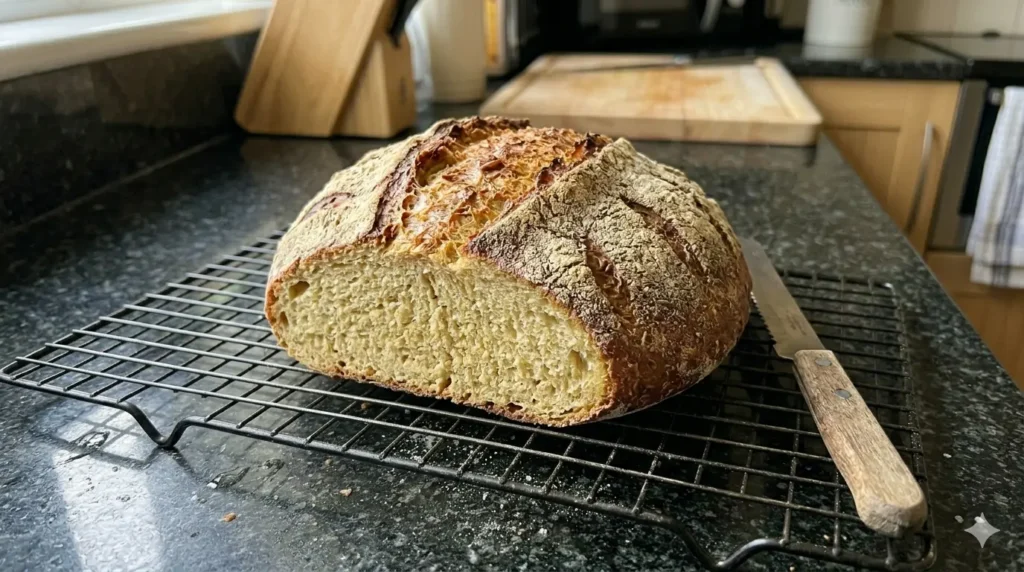
This wholegrain corn bread is made with a mix of stone-ground cornmeal, Spanish W160 bakery flour, and wholemeal flour, baked in a Dutch oven for a proper crust. There's also a cold proof option for anyone who likes to experiment with slow fermentation — I do, and it's worth trying.
The Flours — What They Do and Where to Find Them
Stone-ground cornmeal: This is not the fine white cornflour you use for thickening sauces — it's ground dried corn, closer to fine polenta in texture, with a mild sweetness and a slightly gritty character that gives the bread its distinctive crumb. I use organic stone-ground cornmeal from El Amasadero, a Spanish specialist flour supplier. In the UK it should be available in larger supermarkets or online — look for fine cornmeal rather than polenta, which is coarser.
W160 bakery flour: A Spanish professional baker's flour with a W value of 160, meaning low to medium gluten strength. It's used for doughs that don't need long fermentation or high elasticity — exactly what this bread requires. Not widely available outside Spain, but strong white bread flour is a perfectly good substitute for British bakers.
Wholemeal flour: Adds depth, fibre, and a slightly earthy flavour that balances the sweetness of the corn. Standard wholemeal from any supermarket works well.
H2: Wholegrain Corn Bread — The Method
Ingredients (makes 1 medium loaf)
- 250g organic stone-ground cornmeal
- 125g W160 bakery flour (or strong white bread flour)
- 125g wholemeal flour
- 1½ tsp sea salt
- 1 tbsp organic honey
- 1 tbsp extra virgin olive oil
- 7g dried yeast
- 300ml warm water
Method
- Mix the yeast with 100ml of the warm water and the honey in a small bowl. Leave for 5–10 minutes until frothy.
- Combine the flours and salt in the bowl of a KitchenAid mixer fitted with a dough hook. Add the yeast mixture, remaining 200ml warm water, and olive oil.
- Mix on low speed for 2 minutes until the dough comes together, then increase to medium speed and knead for 8–10 minutes. The dough will be slightly sticky but should feel smooth. This dough is softer than a standard wheat loaf — the absence of gluten in the cornmeal means it won't develop the same elasticity. That's expected.
- Transfer to a lightly oiled bowl, cover, and leave to rise in a warm place for 1–1½ hours until doubled in size.
- Turn out onto a floured surface, shape into a ball, and either place in a lightly floured banneton seam-side up or directly onto a sheet of baking parchment. Leave to rest for 30–45 minutes while the oven preheats.
- Place the Dutch oven with its lid in the oven and preheat to 230°C (210°C fan) for 30 minutes — the Dutch oven needs to be properly hot before the dough goes in.
- Carefully lower the dough into the hot Dutch oven. Cover with the lid and bake for 25 minutes, then remove the lid and bake for a further 10–15 minutes until the crust is deeply golden.
- Transfer to a wire rack and cool for at least one hour before slicing.
Cold Proofing Your Wholegrain Corn Bread — Worth the Wait
Cold proofing is optional but worth trying if you like experimenting. Retarding the dough in the fridge overnight slows the fermentation right down, which develops a deeper, more complex flavour and produces a slightly more open crumb.
How to cold proof this loaf:
- After shaping, place the dough in a lightly floured banneton seam-side up.
- Cover and refrigerate at around 4°C for 8–16 hours.
- When ready to bake, preheat the oven and Dutch oven as above — no need to bring the dough to room temperature first. It goes straight from the fridge into the hot pot.
The crust tends to be slightly more blistered with a cold proof, and the crumb a little more irregular. Neither is a problem — both are signs that something interesting happened overnight in the fridge.
Wholegrain Corn Bread — Notes from the Casa Adora Kitchen
The cornmeal: Fine stone-ground cornmeal, not polenta and not the white cornflour used for sauces. If you're in Spain, El Amasadero is the reliable source. If you're in the UK, look online — it's increasingly available.
The Dutch oven: The enclosed environment traps steam in the early stages of baking, which is what gives the crust its character. Without it you'll get a decent loaf but a softer crust. A cast iron casserole with a tight-fitting lid does the same job.
The banneton: Useful for shaping and producing a nice crust pattern, but not essential. A well-floured bowl lined with a clean tea towel works just as well.
The texture: This loaf is softer and less chewy than a pure wheat loaf. That's the corn flour doing its job. If you want more chew, reduce the cornmeal to 150g and increase the W160 accordingly.
The experiment: It works. I'll make it again.
This wholegrain corn bread recipe is part of my Bread Recipes collection and my Gut Health Recipes collection — real food from a rural Andalucían kitchen, built around fermented foods, high-fibre pulses, wholegrains and prebiotic-rich ingredients.
Find more recipes and food adventures here.
Wonky photos, proper bread, genuine adventures — The Flexible Chef