
Salt is the one ingredient that's always within reach in my kitchen – a pinch here, a finish there. At Casa Adora I keep three on the shelf: fine sea salt for everyday cooking, Maldon sea salt flakes for finishing, and celery salt I make myself from dried celery leaves. Table salt hasn't been in the kitchen for years.
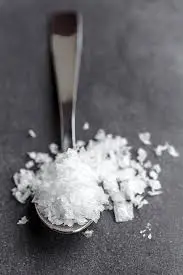
But the question of whether natural salt is actually healthier than table salt is worth answering honestly – because the marketing around pink Himalayan salt, Celtic grey salt, and artisan sea salts can make it sound like a life-changing decision. It isn't, quite. It does matter, but in a different way.
I know this partly because I nearly bought a box of pink Himalayan salt in Asia. A quick bit of research stopped me — the market for fake pink salt, dyed and repackaged, is substantial enough to give you pause. I put it back on the shelf and came home to my Maldon.
Natural Salt vs Table Salt — What's Actually Different?
All salt is primarily sodium chloride. Your body processes natural salt and table salt in exactly the same way — there's no metabolic difference, no special health pathway that opens up because your salt was hand-harvested in Brittany or mined from an ancient seabed in Pakistan.
What does differ is what else is in it.
Table salt is highly refined — typically 97–99% sodium chloride — with iodine added to prevent deficiency and anti-caking agents to keep it flowing freely. Natural salts are less processed and contain trace minerals – magnesium, calcium, potassium, and iron – though in quantities too small to make a meaningful nutritional contribution.
The World Health Organisation recommends no more than 5g of salt per day — roughly one teaspoon — regardless of whether it's Maldon, Himalayan, Celtic, or plain table salt. The health concern is always sodium intake, not the source.
So why bother with natural salt at all? Flavour, texture, and the absence of additives. Which brings me to Maldon.
Pink Himalayan Salt — The Hype, the Fakes, and Why I Left It on the Shelf
Himalayan pink salt is mined from ancient sea deposits in the Punjab region of Pakistan — primarily the Khewra Salt Mine, one of the largest in the world. The pink colour comes from trace iron oxide. It's real, it exists, and it has a devoted following.
It also has a substantial counterfeit market.
When I came across pink salt in Asia, I was tempted. It looked beautiful – deep rose, chunky crystals, the kind of thing you want on your kitchen shelf. But a quick bit of research revealed something worth knowing: a significant proportion of pink salt on the market is ordinary salt dyed pink and repackaged for the premium end of the shelf. Without knowing your source, you're taking a chance.
I put it back. Not because Himalayan pink salt is bad — the genuine article is a perfectly good natural salt — but because I couldn't verify what I was looking at. When I can't trust the provenance of an ingredient, I'd rather walk away.
Back home at Casa Adora, I went back to my Maldon.
The Benefits of Maldon Sea Salt — Why It Earns Its Place on the Shelf
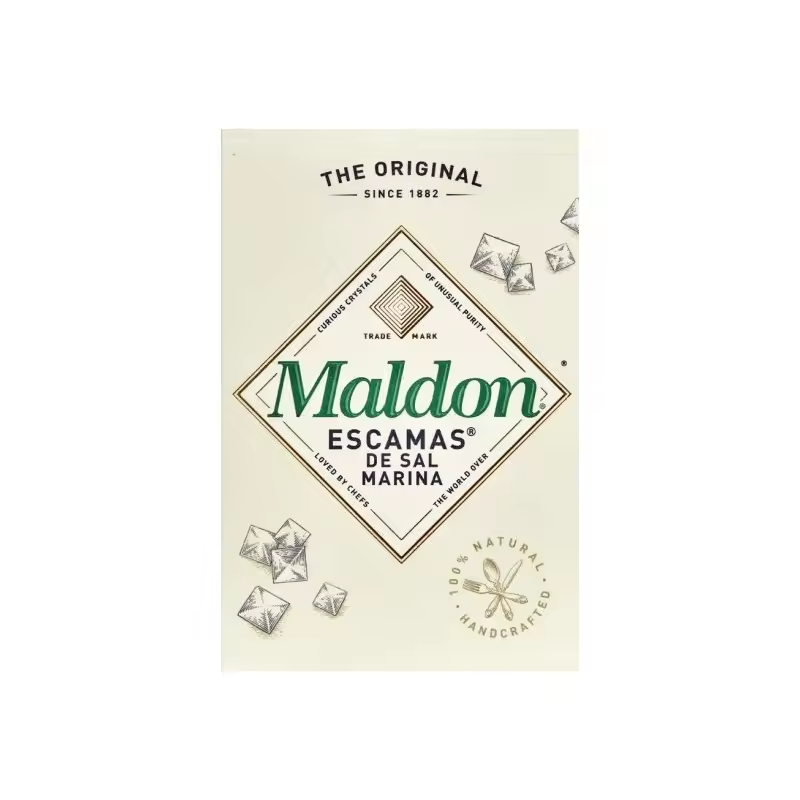
Maldon sea salt has been hand-harvested in Essex since 1882. The flakes are naturally white, free of additives, and have a clean, pure flavour – but it's the texture that sets it apart. Those large, delicate pyramidal flakes dissolve gently on hot food, add a satisfying crunch as a finishing salt, and cover more surface area by weight than fine salt, which means you often need less.
I use it as a finishing salt — a pinch over grilled fish, scattered over focaccia fresh from the cast iron pan, pressed into dark chocolate. It lifts without overpowering.
And here's something worth knowing if you're cooking in Spain: Maldon is widely available in Spanish supermarkets as 'Escamas de sal marina' – the same salt, the same quality, no Brexit import headaches. It sits on the shelf at Mercadona next to the local sea salts and costs roughly the same.
For everyday cooking I reach for fine sea salt. For finishing, it's Maldon. The box lasts a long time because a little goes a long way.
How I Season Without Salt
Salt is essential, but it isn't the only way to build flavour. In my kitchen — at Casa Adora and in the van — I often let herbs and spices do the heavy lifting, keeping the salt for finishing rather than cooking.
A few things I reach for instead:
Celery seeds in soups and stews – they add a savoury, slightly bitter depth that works particularly well with root vegetables and pulses. I also make my own celery salt from dried celery leaves mixed with Maldon — if you want to try it, the recipe is here.
Fresh herbs — rosemary growing outside the door at Casa Adora, coriander; and thyme. Added at the right moment, they reduce the need for salt considerably.
Fragrant spices — smoked paprika, cumin, and fennel seed. These build flavour from the bottom up rather than simply seasoning at the end.
None of this means cooking without salt — it means using it with intention rather than habit. A pinch of Maldon at the end of cooking often does more than salt added throughout.
Natural Salt — A Few Final Thoughts
Is natural salt healthier than table salt? Not dramatically. But it is less processed, free of additives, and – in the case of Maldon – genuinely better to cook with in terms of flavour and texture.
The health decision that actually matters is how much salt you use, not which salt you choose. Keep it to around 5 grams a day; build flavour with herbs and spices; and save the good stuff for finishing.
In my kitchen the hierarchy is simple: fine sea salt for cooking, homemade celery salt for soups and stews, and Maldon escamas for everything that deserves a proper finish.
If salt's got you thinking about the store-cupboard ingredients you take for granted, my What's All This Caper? is in the same spirit.
Find more recipes and food adventures here.
Wonky photos, proper food, genuine adventures – The Flexible Chef




I'm not a big fan of salt but I use sea salt flakes when a recipe calls for it.
I love the idea of using celery seeds instead - they're good for you too.
J. X
P.S. I never say no to a few sea salt flakes on a boiled egg though.
Too much salt is bad for you, causes problems as you age. Avoid processed foods which is full of it or food packed in salt. Also, avoid sugar.
Cut out both and you'll live a long life!
I'm addicted to salt. I have it on everything!
What about fish and chips chef, never had salt on them?
JB