Kisra As-Sorghum — Sudanese Fermented Flatbread - Casa Adora
Kisra is the daily bread of Sudan. Thin, fermented, slightly sour — it looks like a large soft crepe, or injera, its Ethiopian cousin. It is made from sorghum flour, fermented overnight with yogurt or a natural starter, then poured onto a hot metal plate called a saaj and spread fast. The result is a gluten free flatbread recipe with roots that go back thousands of years in the Nile Valley.
At Casa Adora it is cooked on a flat cast iron pan. The saaj is not available in rural Andalucía. The technique is the same.
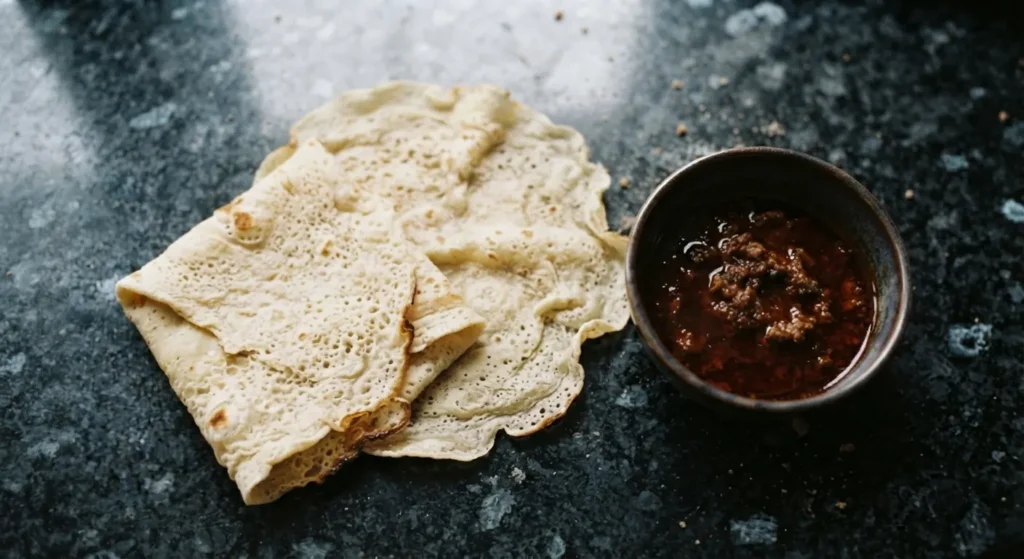
Kisra exists to carry stew. Specifically, it exists to carry Mullah Ahmar — the Sudanese red stew with okra and minced beef that is its natural companion. You tear a piece, scoop, and eat. No cutlery required.
Gluten Free Flatbread Recipe — The Sorghum Difference
Sorghum is one of the oldest cultivated grains in the world, originating in North-East Africa and spreading along trade routes from there. It contains no gluten — making kisra naturally suitable for coeliacs and anyone avoiding wheat — and has a mild, slightly earthy flavour that fermentation deepens considerably.
This gluten free flatbread recipe uses yogurt as the fermentation starter rather than a traditional culture. According to research published in ScienceDirect, fermentation of kisra involves lactic acid bacteria and yeast, which enhances the bread's protein digestibility. The overnight rest does real nutritional work, not just flavour work.
The result sits somewhere between injera and a sourdough crepe — sour, slightly chewy at the edges, thin enough to fold and scoop. If you know injera, you know the territory. Kisra is its Sudanese counterpart — same logic, different grain, different tradition.
The Fermentation
Mix sorghum flour and water to a smooth, pourable batter. Add yogurt as the starter. Cover and leave overnight at room temperature — in Andalucía in September, 8 hours is enough. The batter will bubble gently and smell pleasantly sour. That's correct. That's al wish for bread — the moment it becomes itself.
The Cooking
A flat cast iron pan, hot and lightly oiled. Pour a ladleful of batter and spread quickly in a circular motion — thin, like a crepe. Cook until the surface is set and the edges begin to lift, 2–3 minutes. No flipping needed. Slide onto a plate and repeat.
Serve immediately alongside Mullah Ahmar or any rich stew.
Ingredients
(Makes 6–8 medium flatbreads)
- 200g sorghum flour
- 300ml water
- 2 tbsp plain yogurt
- Pinch of salt
- Light oil for the pan
Method
Ferment:
Mix the sorghum flour, water and yogurt in a bowl until smooth. Cover with a clean cloth and leave at room temperature for 8–12 hours or overnight. The batter should bubble gently and smell pleasantly sour.
Cook:
Heat a flat cast iron pan over medium-high heat. Brush lightly with oil. Pour a ladleful of batter and spread quickly in a thin, circular motion. Cook for 2–3 minutes until the surface is set and the edges lift cleanly from the pan. No flipping needed. Slide onto a plate.
The fermentation bubbles create a characteristic lacy texture as the batter hits the hot pan — visible proof that the overnight rest has done its work.
Serve:
Immediately alongside Mullah Ahmar or any rich stew. Tear and scoop.
Chef's Notes
Teff variation: teff flour works in place of sorghum — the technique is identical and the result is closer to Ethiopian injera. Both are naturally gluten free flatbread recipes with deep fermentation traditions. Use the same quantities.
The saaj: the traditional Sudanese cooking surface is a large, slightly convex metal plate heated over fire. A flat cast iron pan is the practical substitute — get it properly hot before the first pour.
Spreading: speed matters. Pour and spread in one motion. Hesitate and the batter sets before it's thin enough. Practice on the second one — the first is always for the cook.
Yogurt quantity: more yogurt means faster, more pronounced fermentation. In cooler kitchens, increase to 3 tablespoons. In Andalucía in September, 2 tablespoons and 8 hours is enough.
This gluten free flatbread recipe is featured in my North African Recipes hub — Sudan section.
It also features in my Fermentation Hub and my Gut Health Recipes hub.
Find more recipes and food adventures here.
Wonky photos, proper food, genuine adventures – The Flexible Chef