
Tuh'u — Ancient Mesopotamian Lamb Stew
Three cuneiform clay tablets held at Yale's Babylonian Collection, dating to around 1700 BC, contain 35 recipes — the oldest written recipes ever found. They are ancient Mesopotamian recipes in the most literal sense: instructions carved in clay by cooks who lived nearly four thousand years ago, for food that people actually ate. This is one of them.
The Yale Culinary Tablets, as they're known, are dominated by lamb and grain stews. But the everyday Mesopotamian diet was broader than that — grains, pulses, the onion family, river fish, and beer. Lots of beer. Lamb was the prestige ingredient, which is probably why it made it onto the tablets.
Not all 35 recipes are as detailed as tuh'u. One simply reads: meat, water, salt, dried barley cakes, onion, Persian shallot, milk, leek, garlic. A list of ingredients with the method left to whoever was cooking — presumably because they already knew. The writer has been dead for four thousand years, so there's no asking them to fill in the gaps. What it does tell you is that barley was fundamental to the Mesopotamian kitchen, which is why it's in this version.
Tuh'u is one of the ancient Mesopotamian recipes from the Yale tablets — a lamb stew — onion, garlic, leeks, shallots, greens, fresh coriander, cumin, beer, and pearl barley, built around a properly seared base of lamb shoulder. The BBC published a version based on academic research into the tablets, and I've used it as my starting point. But I've made it mine: lamb shoulder from the freezer instead of mutton, chard instead of beetroot (the BBC calls for a pound of diced beetroot, but their own finished dish shows no trace of it — which raised enough questions that I've gone with chard instead, a more plausible ancient ingredient anyway), French shallots in place of Persian shallots — unlikely to be found in rural Jaén, or most places outside a specialist Middle Eastern grocer — and a pale beer with a squeeze of lemon standing in for the sour beer the original calls for. The spirit of the dish is intact. The substitutions are defensible, not compromises.
The BBC recipe also calls for rendered sheep fat. I've used duck fat, which handles the high heat of the initial sear better than olive oil and adds a richness that mutton would have brought to the original.
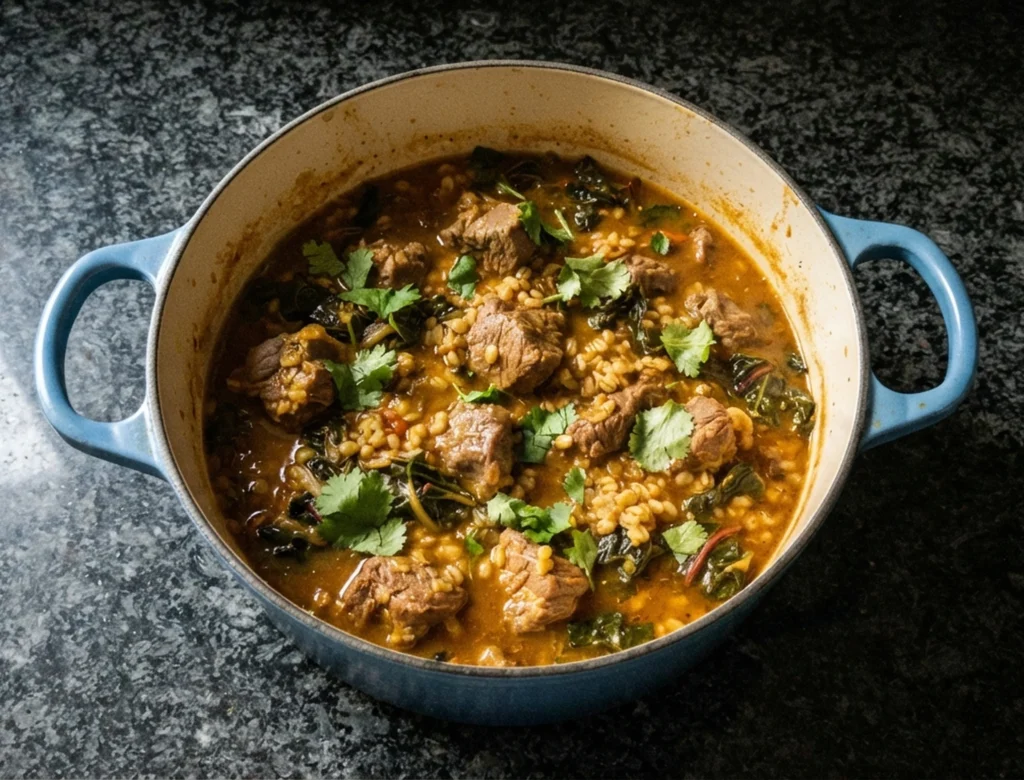
The recipe also calls for rendered sheep fat. I've used duck fat, which handles the high heat of the initial sear better than olive oil and adds a richness that mutton would have brought to the original. A splash of olive oil at the end if you want it.
Ancient Mesopotamian Recipes — Tuh'u
Ingredients
- 300g lamb shoulder, diced
- 1 tbsp duck fat
- 2 French shallots, chopped
- 1 small onion, chopped
- ¼ tsp sea salt
- 2 large chard leaves, chopped
- Small handful of rocket, chopped
- Small bunch of fresh coriander, chopped
- ½ tsp cumin seeds
- 150ml pale beer
- 1 tbsp lemon juice
- 150ml water
- 40g pearl barley
- ½ leek, chopped
- 2 garlic cloves, crushed
- For the garnish:
- Small handful of fresh coriander, finely chopped
- Small handful of spring leek or leek greens, finely chopped
- ½ tsp coriander seeds, coarsely crushed
- To serve:
- 60g bulgur, cooked
- Half a tin of chickpeas, drained and warmed
- Spelt flatbread
Method
- Heat the duck fat in a wide, heavy pot over high heat. Add the diced lamb in a single layer and sear hard, folding occasionally, until all the moisture has evaporated and the lamb is beginning to catch and colour. Don't rush this — it's where the flavour base starts.
- Add the onion and shallots and keep folding over high heat until they begin to soften and turn translucent.
- Add the salt, chard, rocket, fresh coriander, and cumin seeds. Keep folding until the moisture from the greens has fully evaporated and everything is beginning to catch slightly on the bottom of the pot. This is the second evaporation — don't add the beer until the pan is dry again.
- Pour in the beer and lemon juice, then add the water and pearl barley. Give everything a light stir and bring to the boil.
- Reduce the heat, add the leek and garlic, and simmer uncovered for around an hour until the barley is tender, the sauce has thickened and the lamb is falling apart.
- While the stew finishes, pound the spring leek or leek greens and fresh coriander together in a mortar and pestle until you have a rough paste. Ladle the stew into bowls. Spoon the coriander and leek paste over the top and scatter with the crushed coriander seeds. Serve alongside bulgur, warmed chickpeas, and spelt flatbread.
What These Ancient Mesopotamian Recipes Tell Us
The technique here — sear hard, evaporate twice, build the base before any liquid goes in — is identical to what you'd do with a ragù or a proper braise today. Four thousand years of cooking and the fundamentals haven't moved. These ancient Mesopotamian recipes don't give timings or quantities; those were presumably in the head of whoever was cooking. But the method is recognisable. These were people who knew what they were doing.
Footnote:
This ancient Mesopotamian lamb stew is featured in my Cooking Through History hub, where I cook my way through the ancient world — from Mesopotamian flatbreads to Medieval English pottage.
You'll also find it in my Lamb & Goat Recipes hub, my Slow Cooker & Slow Cooking Recipes hub, and my Gut Health Recipes collection — real food from a rural Andalucían kitchen, built around fermented foods, high-fibre pulses, wholegrains and prebiotic-rich ingredients.
Find more recipes and food adventures here.
Wonky photos, proper food, genuine adventures — The Flexible Chef





Looks delish!
100% Trying that! 👍