
Nearly Comptons — Homemade Gravy Salt Recipe
My sister is on a sentimental journey to Montrose, Scotland. She's there to say a final farewell to our Uncle Bert — Robert Morrison, 1927–2026 — at Sleepy Hillock cemetery. While she was there, she sent me a photograph of a packet of Comptons Gravy Salt and a single line: "This is why your stovies don't taste like Granny Morrison's. X"
She was right.
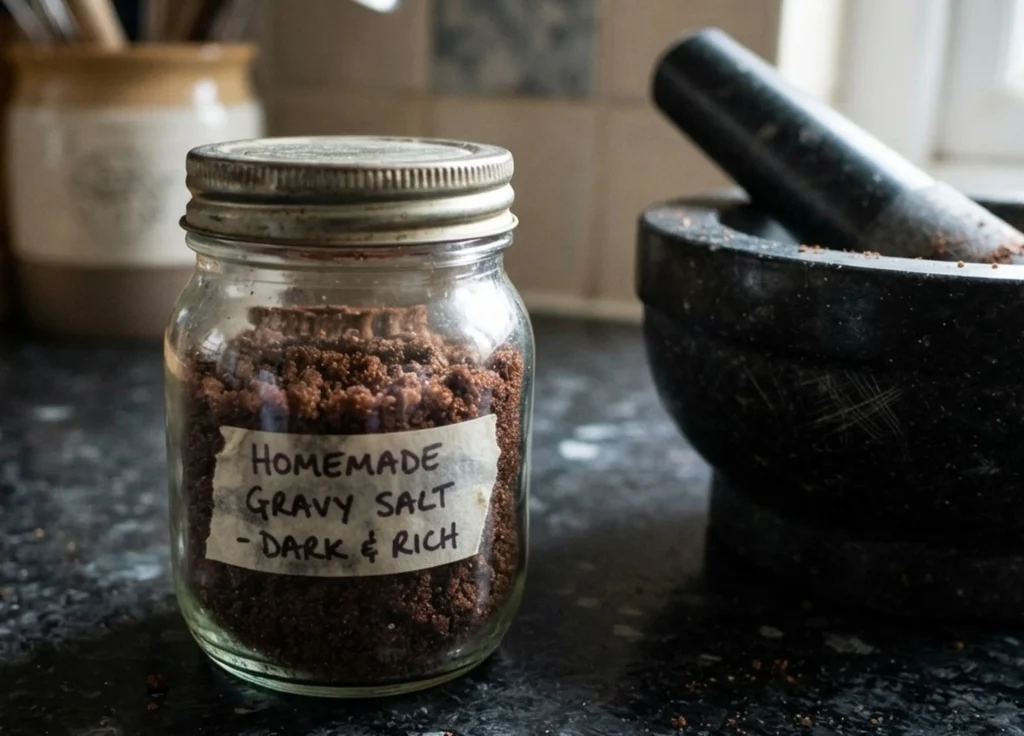
Comptons Gravy Salt is a Scottish cupboard staple — salt, cornflour and caramel, blended into a dark, savoury powder that colours and seasons gravy in a single step. It's been in Scottish kitchens for generations. It is entirely unavailable in rural Andalucía. Which means this homemade gravy salt recipe is happening.
A Brief History of Comptons Gravy Salt
Comptons has been the secret to real gravy since the early 1920s, originally manufactured by Carter's of Sheffield — the same city that gave the world Henderson's Relish, which I've already tackled in the Nearly Series. Between 1924 and 1927, Carter's issued seven sets of collectible football cards given away free inside special tins; customers could save them and trade them in for gifts like pocket knives, tennis balls or a hair comb. The cards are still sought after by collectors today — at auction they can command £45 each.
Production moved to Carlisle in 1994 under Bonds of London & Penguin Confectionery, and in 2004 the brand was acquired by Teasdales Confectionery — run by Janette and Wilson Deyermond — who have kept the original recipe alive ever since. Over a century old and still going. Not bad for a packet of seasoned salt.
What Is Gravy Salt — And Why Make Your Own?
Gravy salt is not a sophisticated product. It is salt — mostly — with a little cornflour for thickening and caramel powder for colour. Add half a teaspoon to a pan of stock and it turns immediately dark, glossy and savoury. It's the thing that gives Scottish stovies, mince and tatties, and Scots-style gravy their particular depth and colour. Without it, the dish is fine. With it, it tastes like someone's grandmother made it.
Comptons has three ingredients. So does this homemade gravy salt recipe.
The Caramel Powder — Make This First
The only ingredient you can't buy off a shelf in rural Andalucía is caramel powder. So you make it. Dark brown sugar goes into a dry pan, melts slowly, turns deep mahogany, and gets poured onto baking paper to cool and harden. Then it gets ground to a powder. The dark brown sugar — rather than white — adds a faint treacly depth that is, if anything, an improvement on the original.
Watch it carefully. Dark brown sugar darkens faster than white and the colour is harder to read. You want deep brown, not black.
- Add 150g dark brown sugar to a small dry pan.
- Heat gently, without stirring, until it melts and turns deep mahogany brown.
- Immediately pour onto baking paper or a silicone mat in a thin layer.
- Leave to cool fully until rock-hard — allow a little longer than you'd expect, dark brown sugar retains moisture.
- Break into shards and grind to a fine powder in a spice grinder or mortar and pestle.
- Measure out 10g for the recipe. Store the rest airtight — it keeps indefinitely and has other uses.
The Homemade Gravy Salt Recipe — Makes approx. 200g
- 160g fine sea salt
- 30g cornflour
- 10g dark brown sugar caramel powder
Combine all three. Mix thoroughly until the colour is completely even. Store in a small airtight jar. It keeps indefinitely.
How to Use It
This homemade gravy salt recipe behaves exactly like Comptons: add ½–1 teaspoon per 250ml of gravy or stock. It colours immediately and seasons as it goes — salty, dark, and slightly thickening. Use it wherever a recipe calls for gravy browning, gravy salt, or anywhere you want that particular dark, savoury depth that is, let's be honest, the difference between good stovies and Granny Morrison's stovies.
The stovies are coming. In the meantime, you'll find my Scottish Stovies — Agnes Isabella's Monday Plate already on the site. They're good. They're about to get better.
This homemade gravy salt recipe is part of the Nearly Series — cupboard classics made from scratch in a Spanish kitchen. Explore the full collection.
Find more recipes and food adventures here.
Wonky photos, proper condiments, genuine adventures — The Flexible Chef



I'm going to try this. Fed up of food moths getting into my gravy salt and ruining it. Sounds fabulous.