Rabbit Haggis Recipe — A Wild Game Twist on Haggis
Hunting season has started, and the rabbits are back. Not just in the fields around Casa Adora — though there are plenty of those — but on the worktop, courtesy of the local cazadores who seem to regard a Morrison with a freezer as a public service.
Hugh Fearnley-Whittingstall has long made the case that a garden pest is also a free-range, high-welfare, zero-food-miles meal. His nose-to-tail philosophy — waste nothing, use the offal, make the casing count — is the spirit behind this rabbit haggis recipe. It's not his recipe. But this rabbit haggis recipe is very much his fault.
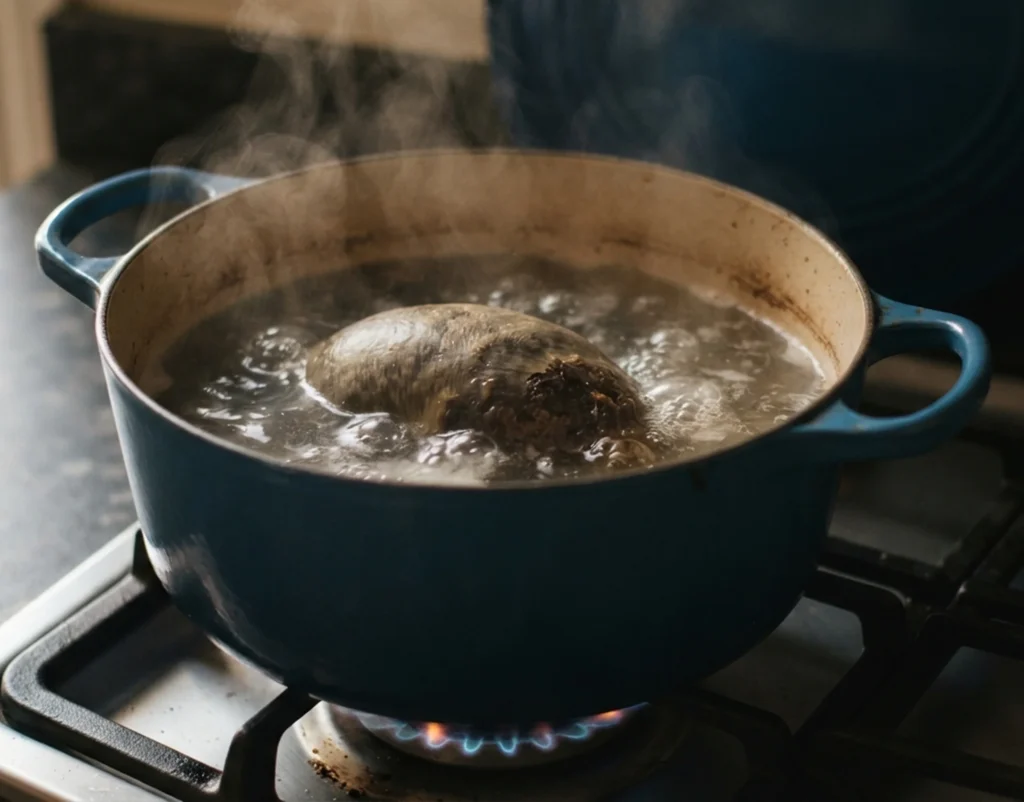
The casing is Rosa's. My neighbour next door makes her own chorizo and morcilla, and when I explained what I was attempting, she handed over a length of hog casing without batting an eye. A Barcelona woman in rural Andalucía providing the wrapper for a Scottish recipe. The Flexible Chef operates in mysterious ways.
The result is a proper wild game haggis — rabbit meat and offal, pinhead oatmeal, jamon for richness, and the usual warm spice combination of mace, ginger and allspice. Serve it with clapshot and something cold to drink. It makes enough for two, so one goes in the freezer for a night when you can't be bothered but still want to eat well.
What goes into a rabbit haggis recipe?
Haggis is a traditional Scottish dish — offal, oatmeal, suet and spices packed into a casing and simmered low and slow. The original uses sheep's pluck and stomach; this version swaps in wild rabbit, which is leaner, more delicate, and considerably easier to source in rural Spain than a sheep's stomach.
The principle is identical. The binder is pinhead oatmeal. The seasoning is mace, ginger and allspice. The cooking method is a long, gentle poach. What changes is the meat — and the fact that jamon replaces suet, which is not a hardship.
Why wild rabbit?
Wild rabbit is genuinely good eating. Lean, flavourful, and — at this time of year — abundant. It has more character than farmed rabbit and responds well to slow, moist cooking, which haggis provides by design. The offal adds depth; the oatmeal absorbs the cooking juices and swells into something properly substantial.
If you've been looking for a reason to do something more interesting with a brace from the cazador down the road, this is it.
Ingredients (serves 2 — one for now, one for the freezer)
- ~400g wild rabbit meat (leg meat, minced or very finely chopped)
- Rabbit pluck — heart, liver and lungs, finely minced
- 80g pinhead oatmeal, soaked in cold water for 30 minutes then drained
- 60g jamon, very finely diced
- 1 tsp ground mace
- ½ tsp ground ginger
- ½ tsp ground allspice
- 1 tsp black pepper
- Salt to taste (go carefully — the jamon carries salt)
- Natural hog casing (soaked overnight in cold water, rinsed well)
- 1 tbsp whisky (optional — into the poaching water)
Method
Prepare the casing
Soak the hog casing overnight in cold water. Rinse thoroughly before using — run cold water through the inside if you can. Set aside.
Make the filling
Drain the soaked oatmeal well. Combine the minced rabbit meat, minced offal, oatmeal and diced jamon in a large bowl. Add the mace, ginger, allspice and black pepper. Mix thoroughly with your hands until everything is evenly distributed.
Pinch off a small amount, shape it into a patty, and fry it in a dry pan until cooked through. Taste it. Adjust the seasoning — bearing in mind the jamon will assert itself more during the long cook.
Fill the casing
Using a sausage stuffer or a wide funnel, fill the hog casing with the mixture. Pack it firmly but not too tightly — the oatmeal will expand during cooking. Tie off at both ends with butcher's string, leaving a small gap between the filling and the string to allow for that expansion. Prick the casing all over with a needle or skewer.
Cook
To poach: Lower the haggis into a pan of cold water and bring slowly to a gentle simmer. Add the whisky to the water if using. Cook at a low simmer — not a rolling boil, which will burst the casing — for 1 to 1½ hours, until the internal temperature reaches 75°C. Keep an eye on the water level and top up if needed.
To bake: Wrap in foil, place in a roasting tin with a shallow layer of water, and cook at 150°C (130°C fan) for up to 2 hours. Rest before serving.
Serve
Split the haggis open at the table and serve alongside clapshot — the Orcadian combination of neeps and tatties that is the natural partner for anything in this register.
A note on the offal
Using the full pluck — heart, liver and lungs — gives the haggis its depth. The lungs in particular add a lightness to the texture that you don't get from liver alone. If lungs aren't available, heart and liver will do the job; the result will be slightly richer and denser, which is not a disaster.
Wild rabbit offal is more delicate than sheep offal and cooks faster, which is one reason the long, gentle poach suits this recipe. You're not trying to rush it.
Can I make rabbit haggis without a sausage stuffer?
Yes, with patience. A wide-mouthed funnel and a wooden spoon handle will move the filling into the casing — it takes longer and requires a second pair of hands ideally, but it works. Rosa provided the casings from her own supply. She also let me loose on her sausage stuffer, took one look at the carnage, and quietly took over. There are limits to what neighbourly generosity can watch without intervening.
Footnote
This wild rabbit haggis recipe is featured in my Scottish Recipes collection, a gathering of traditional and adapted Scottish dishes from a Morrison with roots in Clackmannanshire. You'll also find it in my Game Recipes collection.
Find more recipes and food adventures here.
Wonky photos, proper food, genuine adventures — The Flexible Chef