Ribollita Recipe — Tuscan Bread and Bean Soup
The word ribollita means re-boiled, and that single act of re-boiling is what separates this ribollita recipe from every other minestrone-adjacent pot you've ever made. Friday's big vegetable and bean soup becomes Saturday's thicker, richer bowl — re-boiled with yesterday's stale bread already dissolved into the broth, the whole thing silky, dense and deeply satisfying. Each re-boil improves it. That's the rule, and it's a rule that has been followed in Tuscan kitchens for somewhere between seven and twenty centuries, depending on where you draw the lineage.
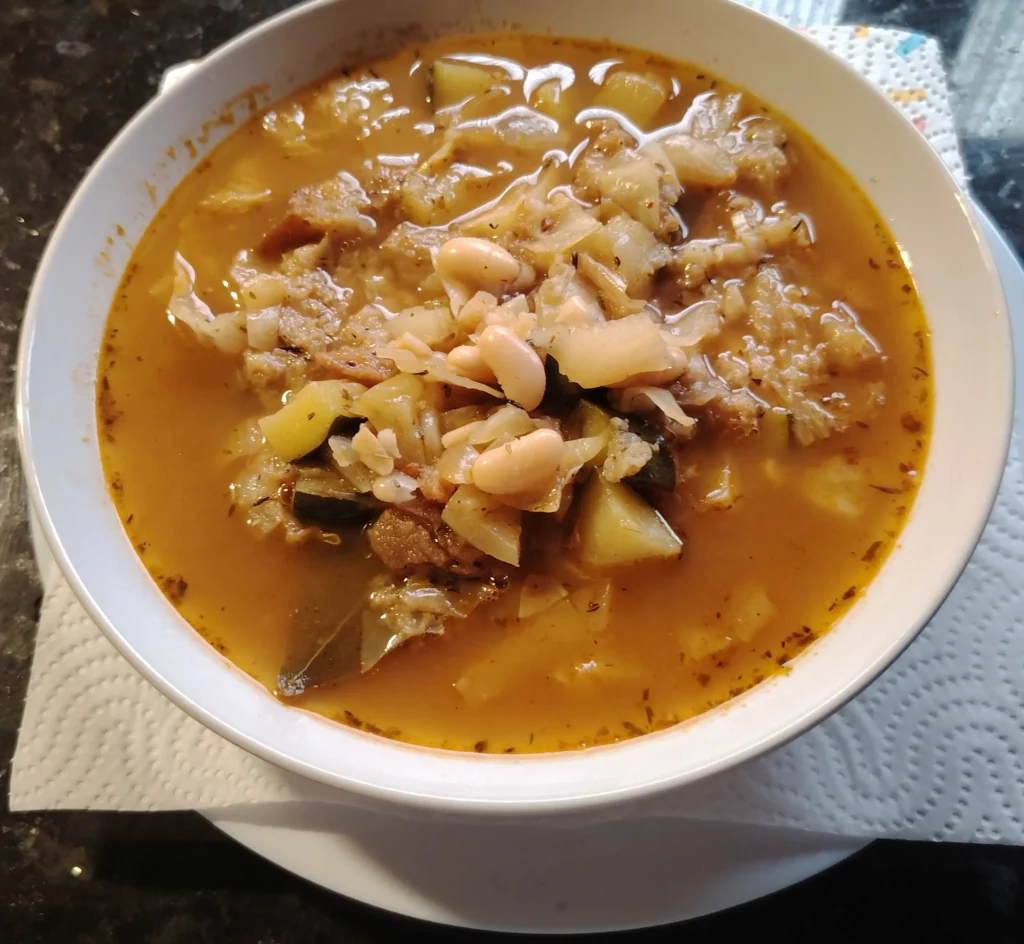
It's one of the most compelling dishes in the Cooking Through History series, not because the recipe is dramatically ancient but because the method is. Would Marcus Aurelius have eaten ribollita? Almost certainly not — he died in 180 AD, a thousand years before the dish acquired its name, and the cannellini bean hadn't arrived in Europe yet. But the logic behind it? Absolutely. Roman pulmentum — the thick porridge-stew of legumes, vegetables and stale bread that fed soldiers, farmers and the urban poor for centuries — is ribollita's direct ancestor. My favourite Roman, Marcus Aurelius, who wrote extensively about eating simply and not being enslaved to appetite, would have approved of the philosophy entirely. The re-boiling habit, the thrifty extension of yesterday's pot, the bread that thickens rather than wastes — this is Roman thinking in a medieval Tuscan bowl.
The ribollita recipe we recognise today is probably 13th or 14th century Tuscany. The cannellini bean arrived with the Columbian Exchange in the 16th century — which means the dish's structure predates its most famous ingredient by at least two hundred years. Cavolo nero was being cultivated in Tuscany long before that. The bread — dense, saltless Tuscan pane sciocco — was simply whatever was stale and to hand. Which brings me to my flex.
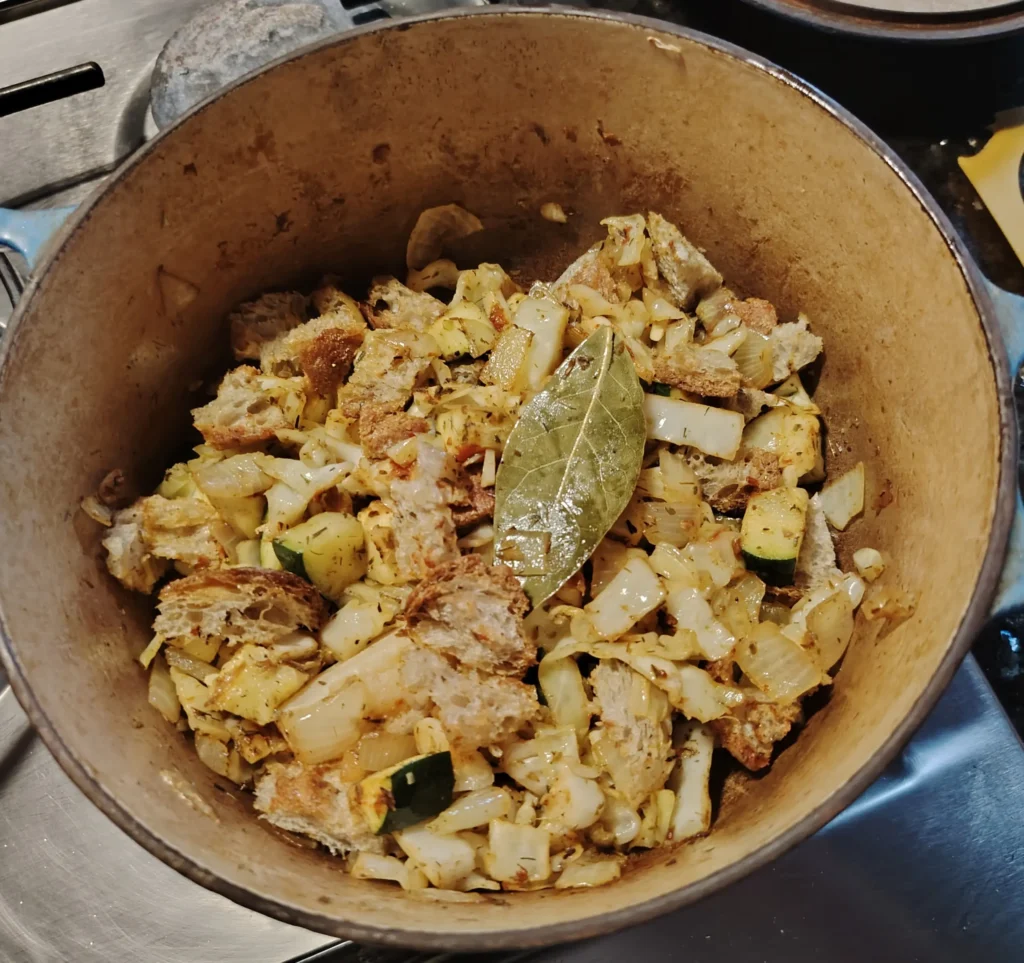
I'm using stale buckwheat sourdough, and I'm adding it early — into the soffritto, before the stock, where it toasts slightly in the oil and absorbs the flavours of the base before the liquid goes in. Some Tuscan cooks do exactly this; others stir the bread in at the end. The early method gives you a deeper, more integrated result, the bread woven through the soup rather than floating on top of it. Buckwheat sourdough has a slightly nutty edge that works beautifully with white beans, and it collapses into the broth in exactly the way you need. Use whatever dense, stale bread you have — the principle is the same.
One more declaration: a tablespoon of tomato purée for colour and depth. Historically indefensible, culinarily essential.
A Ribollita Recipe Rooted in Lean-Season Logic
The dish that became ribollita was almost certainly peasant food from the start. In medieval Tuscany, the saltless bread that the poor baked would go stale within a day or two. Beans were the protein of the rural poor — broad and fava first, cannellini once the New World made them available. Cabbage, courgette, onion and garlic were winter and summer staples respectively. The genius of ribollita is that stale bread isn't a problem to be solved; it's an ingredient. You don't throw it away. You tear it, cook it into the base, and let it absorb everything. The resulting bowl is richer, thicker and more sustaining than the original soup. Poverty cooking at its most elegant.
The name itself tells you the method was the point. Not zuppa toscana, not minestrone di pane — ribollita. The re-boiling is the dish. And that re-boiling habit connects it directly to the Roman practice of keeping a pot at the edge of the fire and extending it over days. The medieval Tuscan kitchen didn't invent this. It inherited it.
A word on the Parmesan rind: drop it into the pot with the stock and let it slowly melt and give the broth a quiet, savoury creaminess. Boccaccio mentioned Parmesan in the Decameron in 1353 — squarely in the ribollita timeline — so this is one of the most historically authentic things in the pot. Fish the rind out before serving.
This version is simple but not austere: white beans, cabbage, courgette, onion, garlic, good homemade stock, thyme, oregano, bay and that Parmesan rind. The tomato purée gives the broth its colour. The buckwheat sourdough, added early, gives it its soul.
Ingredients
Serves 2 — one now, one re-boiled tomorrow
- 1 tbsp extra-virgin olive oil
- 1 medium onion, roughly chopped
- 1 garlic clove, crushed
- A handful of courgette, roughly chopped
- ¼ small white cabbage, roughly shredded
- 1 tbsp tomato purée
- 4 tbsp cannellini beans, drained and rinsed
- 1 litre homemade chicken stock (or good vegetable stock)
- 2 bay leaves
- 1 tsp dried thyme
- 1 tsp dried oregano
- 1 Parmesan rind
- 2–3 thick slices stale buckwheat sourdough (or any dense, stale bread), torn roughly
- Flaky sea salt and black pepper
H2: Method
1. Build the soffritto.
Warm the olive oil in a medium casserole or heavy-based saucepan over a gentle heat. Add the onion and cook slowly for 10–12 minutes until soft and just starting to colour at the edges. Add the crushed garlic and cook for a further 2 minutes.
2. Add the cabbage and courgette.
Stir in the shredded cabbage and courgette, season well with salt and pepper, and cook for 5 minutes until beginning to wilt and take on a little colour.
3. Add the bread.
Tear the stale bread into rough pieces and stir it into the soffritto now, before the stock goes in. Add the tomato purée and stir everything together. Cook for 2–3 minutes, letting the bread toast lightly in the oil and absorb the flavours of the base.
[INSERT PROCESS SHOT HERE — ribollita-recipe-soffritto.webp]
4. Add the beans, stock and aromatics.
Tip in the drained beans, pour over the stock, and add the bay leaves, thyme, oregano and Parmesan rind. Bring to a gentle boil — about 8–10 minutes from cold — then drop to a steady simmer, lid off.
5. Simmer.
Cook uncovered for 25–30 minutes, stirring every 8–10 minutes to stop the bread catching on the bottom. You want the cabbage completely tender, the bread fully dissolved into the broth, and the stock reduced and deepened. The Parmesan rind needs this time to do its work.
6. Rest and finish.
Remove the bay leaves and Parmesan rind. Take the pan off the heat and leave it to sit for 5 minutes — this is where the soup becomes itself. Taste and adjust the seasoning. Ladle into a bowl and finish with a drizzle of good extra-virgin olive oil and a grind of black pepper if you like.
Tomorrow, re-boil it. Add a splash of water, bring it back to a simmer, stir. It will be better. That's the whole point.
The Ribollita Tradition — And Why the Re-Boil Matters
The Tuscan ribollita has a version in almost every region of Tuscany, each with its own village-level conviction that the local method is the only correct one. Cavolo nero versus Savoy cabbage. Cannellini versus borlotti. Bread in early versus bread stirred in at the end. None of it matters half as much as the re-boil. That's the constant. That's the thing that's been passed down.
The earliest written references to something called ribollita appear in the late medieval period — probably 13th or 14th century. But the soup itself is older than its name. Bread and bean soups appear throughout Roman cookery, and the technique of thickening broths with stale bread is documented across the ancient Mediterranean. Ribollita is what happens when that Roman technique meets Tuscan winter produce and a culture with a deeply practical relationship with yesterday's bread.
What I find most interesting — the thing that puts this firmly in the Cooking Through History series — is that this soup is essentially minestrone at a different point in time. Friday's big vegetable pot becomes Saturday's ribollita, thickened with bread, deepened by the re-boil. They're not two dishes; they're one dish at two moments. The medieval Tuscan cook understood that yesterday's pot, with a little patience and a little bread, was always going to be better than today's. Seven centuries later, they were right.
This soup doesn't need reconstructing. It hasn't been lost and rediscovered. It has simply continued, because it works. Lean-season logic, peasant thrift, a Parmesan rind and good stock produce something that no amount of technique or expensive ingredients can improve on. Marcus Aurelius would have approved of the philosophy, even if he'd never seen a cannellini bean in his life.
This ribollita recipe is featured in my Cooking Through History — Historical Recipes hub and my Soup Recipes Hub, where you'll find proper food across both collections.
Find more recipes and food adventures in the Recipe Hubs.
Wonky photos, proper food, genuine adventures — The Flexible Chef