Selkirk Bannock — A Scottish Border Fruit Bread
There are bakers, and there are bakers who get a royal warrant. Robbie Douglas of Selkirk was the latter.
In 1859, Queen Victoria stopped at Abbotsford House — Sir Walter Scott's estate on the banks of the Tweed, a few miles outside Selkirk — and was served Robbie's bannock. She reportedly ate only that, ignoring everything else on the table. The warrant followed. The bannock has been made in the Scottish Borders ever since.
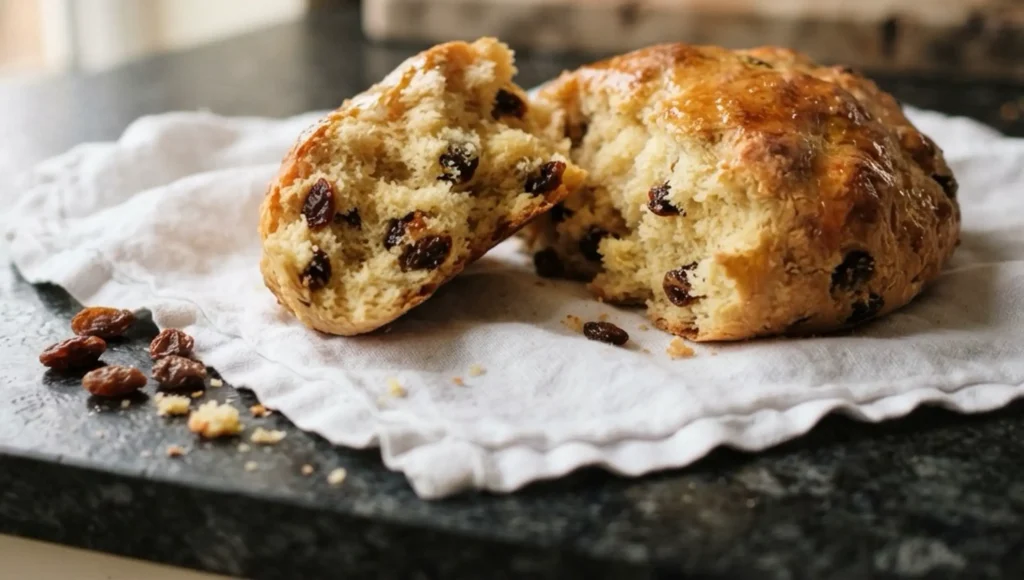
The original is a rich, yeasted fruit bread — strong white dough, plenty of butter, sultanas throughout. No mixed peel. That was Robbie Douglas's firm position, and it remains the traditional line. My version swaps the sugar for local honey — Alcalá la Real market, from bees working the same landscape as the olive groves — and glazes the top with a little more when it comes out of the oven. Rosa next door has the sweet tooth in this village. She and her husband will get most of this loaf. I'll keep the heel.
What Makes a Selkirk Bannock
The bannock takes its name from the town — Selkirk, in the Scottish Borders, about an hour south of Edinburgh on the River Ettrick. It has been made there since at least the early nineteenth century, though the bread almost certainly predates Robbie Douglas. What Douglas did was codify it, sell it in quantity, and attract the right customer at the right moment.
The defining characteristics are these: a yeasted dough (not soda-raised, which sets it apart from its cousin the Fife bannock), enriched with butter, and packed with sultanas. Raisins and mixed peel have both been tried over the years by bakers looking to cut costs or vary the flavour. The purists — and the town — are firmly against both.
My version holds the line on the sultanas. The honey is my own addition.
Ingredients
(Makes one small loaf)
For the dough
- 250g strong white bread flour, plus extra for dusting
- 1 tsp fast-action dried yeast
- ½ tsp fine sea salt
- 1 tbsp local honey
- 30g unsalted butter, softened
- 120–130ml whole milk, warmed
For the fruit
- 120g sultanas (pasas de uva)
For the glaze
- 1 tbsp local honey, warmed
Method
1. Make the dough
Combine the flour, yeast, and salt in a bowl. Add the honey and softened butter, then pour in the warm milk gradually — you may not need it all. Mix to a soft, slightly sticky dough. Turn out onto a lightly floured surface and knead for 8–10 minutes until smooth and elastic. The dough should be pliable but not wet.
2. First rise
Shape into a ball, return to the bowl, cover with a clean cloth, and leave in a warm spot for 1–1½ hours until doubled in size.
3. Incorporate the sultanas
Turn the dough out and flatten gently. Scatter the sultanas over the surface and fold the dough over them repeatedly, working them in evenly. This takes a minute or two — don't rush it. Some will try to escape. Put them back.
4. Shape and second rise
Shape the dough into a round and place on a lightly floured baking tray or in a small cast iron pan. Cover and leave for 45 minutes to an hour until well risen and pillowy.
5. Bake
Preheat the oven to 190°C. Bake for 25–30 minutes until deep golden and hollow-sounding when tapped underneath.
6. Glaze
Remove from the oven and brush immediately with the warmed honey. Leave to cool on a wire rack for at least 20 minutes before cutting.
Chef's Notes
The milk temperature matters — warm to the touch, not hot. Too hot and you'll knock the yeast back before it gets started.
Strong white bread flour gives you the structure the fruit needs. Plain flour produces a closer, denser crumb that doesn't carry the sultanas as well.
If your kitchen is cool (a Spanish winter morning, for instance), the first rise may take closer to two hours. That's fine. Slow is not a problem; under-proved is.
The honey glaze sets quickly on the hot crust. Don't leave it — brush it on straight from the oven.
Selkirk bannock keeps well wrapped in a clean cloth for two to three days. It also freezes well sliced, which is useful when you're baking for one and your neighbours already have a full loaf.
Footnote
This Selkirk bannock is featured in my Scottish Recipes hub and my Bread Recipes collection — traditional and adapted Scottish dishes, and everything from soda breads to enriched loaves.
Find more recipes and food adventures here.
Wonky photos, proper food, genuine adventures — The Flexible Chef