Types of Rice — A Cook's Guide to Every Variety
There are thousands of types of rice grown around the world, and the variety you choose matters more than most cooks realise. The right rice makes a paella sing and a risotto turn properly creamy; the wrong one leaves both flat and disappointing. I have cooked and eaten rice across Asia, Europe and the United States — from fragrant jasmine in Thailand to arroz bomba on the Spanish coast — and each type brings something entirely different to the pot. This guide covers the types of rice you are most likely to encounter, what they are best used for, and how to get the most out of them.
Types of Rice — The Complete List
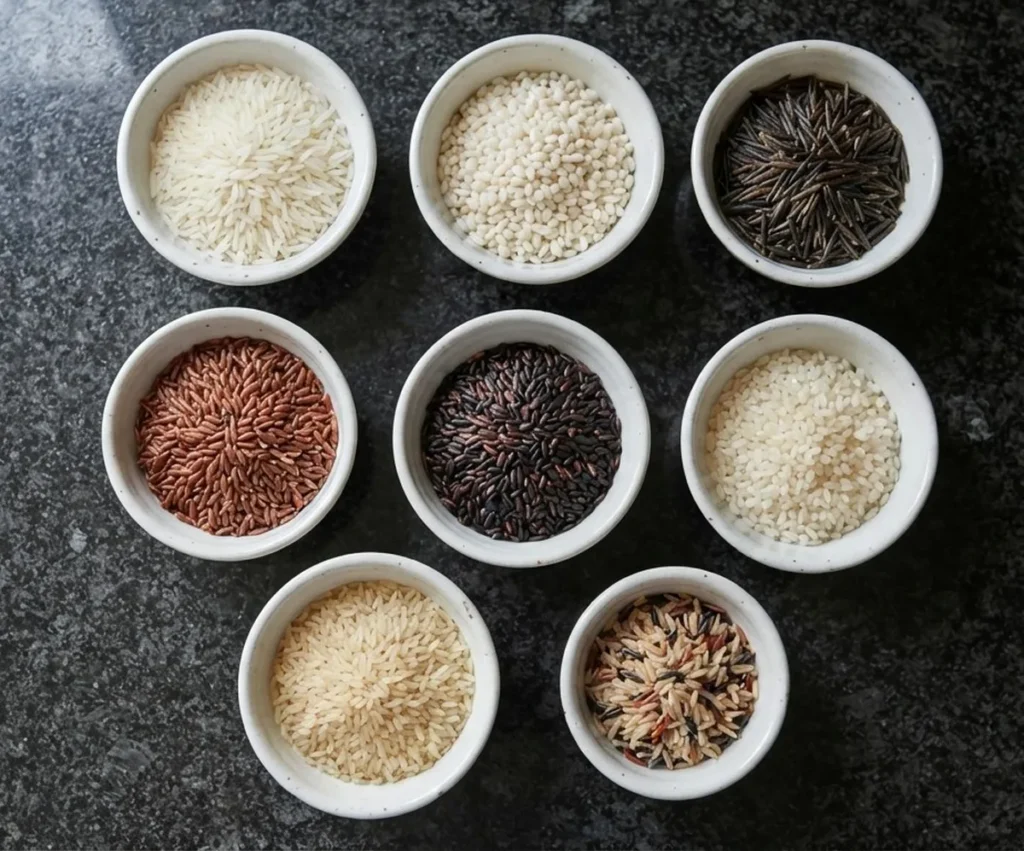
Basmati
The most celebrated of the long-grain rices, basmati is grown in the foothills of the Himalayas in India and Pakistan. The name means fragrant in Hindi, and the aroma when it cooks — nutty, slightly floral — is unmistakable. The grains are long and slender, and when cooked correctly they elongate further and stay beautifully separate. Basmati is the rice of biryanis, pilaus and curries. It should never be sticky. Rinse it well before cooking and, if you have time, soak it for thirty minutes first — it makes a noticeable difference to the texture.
Jasmine
Jasmine rice is the everyday rice of Southeast Asia — Thailand, Vietnam, Cambodia — and if you have eaten rice across that part of the world, as I have, you will know it immediately by its soft, slightly sticky texture and its delicate floral scent. It is a medium-to-long grain rice, shorter and rounder than basmati, and it cooks to a gentle clump rather than separate grains. That slight stickiness is the point — it is designed to be eaten with chopsticks or rolled into a ball with your fingers. Jasmine rice is the natural partner for Thai curries, Vietnamese stir-fries and Cambodian dishes of all kinds. Do not rinse it as thoroughly as basmati; a little surface starch is what gives it its characteristic texture.
American Long Grain
American long grain is the workhorse rice of the United States — widely grown in the southern states, particularly Louisiana, Arkansas and Texas, and the rice most likely to appear as a side dish across the country. The grains are long and firm, cook up dry and separate, and have a mild, neutral flavour that makes them adaptable to almost anything. It lacks the fragrance of basmati or the character of jasmine, but that neutrality is also its strength — it stays out of the way and lets the dish do the talking. It is the natural rice for Cajun and Creole cooking, jambalaya and red beans and rice, and it performs well in any recipe where you want a clean, unfussy base.
Arborio
Arborio is the best known of the Italian risotto rices, named after the town of Arborio in the Po Valley in Piedmont. It is a short, fat, pearly grain with a high starch content — and it is that starch, released slowly during cooking as you add stock ladle by ladle, that gives a properly made risotto its characteristic creamy consistency. The grain stays slightly firm at the centre even when the outside is tender, which is the al dente quality that distinguishes a good risotto from a stodgy one. Arborio is the most widely available risotto rice outside Italy, but if you can find Carnaroli or Vialone Nano, both are worth trying — Carnaroli in particular holds its shape better and is the choice of many Italian chefs.
Carnaroli and Vialone Nano
If Arborio is the most widely known risotto rice, Carnaroli and Vialone Nano are the ones the Italians actually argue about. Carnaroli is often called the king of risotto rices — it has a firmer grain than Arborio, a higher starch content, and holds its shape better through the long cooking process, making it more forgiving for the home cook. Vialone Nano is shorter and rounder, absorbs stock more quickly, and produces a looser, more flowing risotto — the style preferred in Venice and Verona, where risotto all'onda, meaning risotto that waves, is the mark of a properly made dish. Both are worth seeking out. If you can only find Arborio, use it without apology — but if Carnaroli appears on a deli shelf, buy it.
Arroz Bomba
Arroz bomba is the rice of Spanish paella, grown in the wetlands of Valencia around the Albufera lagoon, and it is unlike any other rice in the kitchen. The grains are short, round and dense, and they absorb liquid in a way no other rice quite matches — up to three times their volume, compared to twice for most varieties. That extraordinary absorption is what allows a paella to develop its deep, concentrated flavour, the stock and saffron and sofrito working their way into every grain. Arroz bomba also has a remarkable quality under heat — rather than splitting and turning mushy when overcooked, the grains burst outward while holding their shape, which is where the name comes from. It is more expensive than most rice and worth every cent. I keep arroz bomba in my store cupboard at Casa Adora in Andalucía as a permanent staple — without it, paella is just rice with things in it.
Calrose
Calrose is a medium-grain rice developed in California in the 1940s and now the most widely grown rice variety in the United States. It is the everyday rice of Japanese-American communities and has become the default sushi rice outside Japan, though purists would argue that proper Japanese short-grain varieties are superior. The grains are soft, slightly sticky and tend to clump together when cooked, which makes them easy to handle with chopsticks and good for moulding. Calrose is versatile — it works as a plain steamed rice alongside most Asian dishes, holds together well in rice bowls, and is widely available in supermarkets across the United States, Australia and increasingly Europe. If you cannot find Japanese short-grain rice for sushi, Calrose is the most reliable substitute.
Sushi Rice
Sushi rice is a short-grain Japanese rice — varieties such as Koshihikari are the most prized — with a naturally high starch content that gives it a firm, slightly sticky texture when cooked. What makes sushi rice distinctive is not just the grain itself but what happens after cooking: the rice is seasoned while still hot with a mixture of rice vinegar, sugar and salt, then folded gently and fanned to cool it quickly. This process gives it a subtle sweet-sour flavour and a glossy sheen that plain cooked rice never achieves. The texture needs to be precise — sticky enough to hold its shape when pressed or rolled, but not so glutinous that it becomes gluey. Getting sushi rice right is one of those kitchen skills that takes a little practice and then becomes second nature. Use it for nigiri, maki rolls, onigiri and rice bowls, and never, under any circumstances, rinse the seasoning off after cooking.
Pudding Rice
Pudding rice is a short-grain white rice grown specifically for slow cooking in milk or cream. The grains are small, round and starchy, and they break down gradually during long, gentle cooking to produce the thick, creamy consistency that defines a proper rice pudding. It is the rice of nursery food and Sunday afternoons — simple, comforting and deeply satisfying, or so I am told. School dinners left me with a lasting aversion to rice pudding that decades have not entirely shifted, so I will leave the recipe to those better placed to judge it. What I can say is that in Spain the equivalent — arroz con leche, made with local short-grain rice, cinnamon and lemon zest — is rather more tempting, and if anything were to convert me, that would be it.
Wild Rice
Wild rice is not technically rice at all — it is the seed of an aquatic grass native to the Great Lakes region of North America, where it has been harvested by indigenous communities for centuries. The grains are long, dark and narrow, with a firm, chewy texture and an earthy, nutty flavour quite unlike any cultivated rice variety. It takes longer to cook than most rice — up to forty-five minutes — and the grains split open when done, revealing a pale interior against the dark outer husk. Wild rice is rarely eaten alone; it is most commonly mixed with other rice varieties, which softens its intensity and adds visual drama to the finished dish. I keep wild rice from France in my store cupboard at Casa Adora — the Camargue region produces both wild and red rice of excellent quality, and a handful mixed into a pilau or rice salad lifts the whole thing considerably.
Camargue Red Rice
Camargue red rice is grown in the wetlands of the Rhône delta in the south of France, where the iron-rich soil gives the grain its distinctive russet colour. It is a whole-grain rice — the outer bran layer is left intact — which means it takes longer to cook than white rice, around thirty-five to forty minutes, but rewards the patience with a firm, nutty bite and an earthy depth of flavour that white rice simply cannot match. The colour softens during cooking from a vivid rust to a more muted terracotta, and it bleeds slightly into the cooking water, which can tint a dish pink if you are not careful. I have used Camargue red rice in the sesame and ginger chicken meatball dish on this site, where its firmness and colour work beautifully against the pale meatballs and dark spinach. It is also excellent in rice salads, where the grains hold their shape and texture even when dressed and left to stand. Look for it in good delis and French supermarkets — it is worth seeking out.
Black Rice
Black rice — sometimes called forbidden rice, a name that traces back to ancient China where it was reserved exclusively for the emperor — is a whole-grain rice with a deep, inky purple-black colour that turns dramatically violet when cooked. Like Camargue red rice, the bran layer is intact, which gives it a firm, chewy texture and a nutty, slightly sweet flavour with more complexity than white rice. It is also exceptionally high in anthocyanins, the same antioxidants found in blueberries, which is why it has attracted considerable attention from the health food world in recent years. Cook it for around thirty to thirty-five minutes in plenty of water, as you would pasta, and drain when tender. Black rice works beautifully in rice salads, as a base for fish dishes where the colour contrast is dramatic, and in Southeast Asian desserts where it is cooked with coconut milk and palm sugar. It is increasingly available in larger supermarkets and worth keeping in the store cupboard for the sheer visual impact it brings to a plate.
Brown Rice Brown rice is simply white rice that has not been fully milled — the outer bran layer and germ remain intact, giving it a tan colour, a chewier texture and a nuttier flavour than its white counterpart. It takes considerably longer to cook, typically thirty to forty minutes, and benefits from soaking beforehand. Nutritionally it is significantly more complex than white rice, retaining fibre, vitamins and minerals that the milling process strips away — which is why it appears so frequently in health-conscious cooking. The trade-off is texture and versatility; brown rice does not absorb flavours as readily as white, and it will never produce a proper risotto or a paella. Where it does excel is as a straightforward side dish, in rice salads where its firmness is an advantage, and in grain bowls where its nutty character adds substance. Use it where you want the rice itself to have presence rather than to disappear into the background of a dish.
Glutinous / Sticky Rice Glutinous rice — also known as sticky rice, sweet rice or waxy rice — is a variety of short-grain rice that becomes exceptionally sticky when cooked, due to an almost complete absence of amylose, one of the two starch components found in regular rice. Despite the name it contains no gluten. It is the everyday rice of Laos, where it is eaten at virtually every meal, and it appears throughout Southeast Asia — in Thailand, Cambodia and Vietnam — both in savoury dishes and in desserts. Traditionally it is soaked overnight and then steamed rather than boiled, which produces the characteristic dense, chewy texture that allows it to be rolled into balls and eaten with the fingers. I encountered sticky rice throughout my travels in Southeast Asia, where it arrives at the table in small woven baskets, still warm, and is pulled apart and used to scoop up curries and grilled meats. In its sweet form it appears in dishes like mango sticky rice, arguably one of the great desserts of the region.
Which Rice for Which Dish
The single most useful thing you can know about rice is which variety to reach for. Using the wrong rice is the most common reason a dish underperforms.
Paella — arroz bomba, always. No substitute produces the same result.
Risotto — Carnaroli for the best result, Arborio if that is what you have. Never long-grain.
Biryani and pilau — basmati. The long, separate grains are essential to both dishes.
Curry side dish — basmati or jasmine, depending on the cuisine. Basmati for Indian, jasmine for Thai and Southeast Asian.
Fried rice — day-old jasmine or long-grain. Freshly cooked rice is too wet and will steam rather than fry.
Sushi and rice bowls — sushi rice or Calrose. The stickiness is non-negotiable.
Rice pudding — pudding rice or any short-grain white rice. Arborio works well if pudding rice is unavailable.
Rice salads — Camargue red rice, wild rice, brown rice or any long-grain. You want grains that hold their shape when dressed and left to stand.
Congee — any short or medium-grain white rice. The goal is complete breakdown, so the variety matters less than the cooking time.
Stuffed peppers and tomatoes — medium-grain or short-grain. You want a little stickiness to bind the filling.
Coconut rice — jasmine. The floral notes of jasmine and coconut milk are a natural pairing.
How to Store Rice
Uncooked rice stores well if kept correctly. The enemies are moisture, heat and, in the case of brown and whole-grain varieties, time.
White rice — basmati, jasmine, arborio, arroz bomba and most other milled white rices will keep almost indefinitely if stored in an airtight container in a cool, dry place away from direct sunlight. A sealed jar or container is better than the original paper bag, which absorbs moisture and can attract insects. In a hot climate — and at Casa Adora in Andalucía in August, the kitchen can reach temperatures that would surprise a northern European — an airtight container is not optional, it is essential.
Brown, red and wild rice — whole-grain varieties contain natural oils in the bran layer that turn rancid over time. Store them in an airtight container and use within six months. In a hot climate, the fridge or freezer is a better option for long-term storage.
Cooked rice — cool it as quickly as possible after cooking, ideally within an hour, and refrigerate in a covered container. Use within two days. Never reheat cooked rice more than once, and make sure it is piping hot all the way through before serving. Cooked rice left at room temperature for extended periods can harbour Bacillus cereus, a bacterium that causes food poisoning and is not destroyed by reheating.
How to Cook Rice Properly
The method depends entirely on the variety, but a few principles apply across the board.
Rinsing — most rice benefits from rinsing before cooking. Place the rice in a bowl, cover with cold water, swirl, and pour off the cloudy water. Repeat until the water runs reasonably clear. This removes excess surface starch and, in the case of basmati, produces cleaner, more separate grains. The exception is sushi rice, where you rinse to remove excess starch but stop short of washing away the starch that gives it its characteristic stickiness. Do not rinse risotto rice — the surface starch is what you need.
The absorption method — the most reliable method for basmati, jasmine and long-grain rice. Use a ratio of one part rice to one and a half parts water. Bring to the boil, stir once, reduce to the lowest possible heat, cover tightly and cook for twelve minutes. Remove from the heat and leave to steam, lid on, for a further five minutes. Do not lift the lid during cooking. Fluff with a fork before serving.
The pasta method — for brown rice, wild rice and Camargue red rice. Bring a large pan of salted water to the boil, add the rice and cook uncovered, tasting regularly, until tender. Drain and return to the pan with the lid on for five minutes to finish steaming.
Risotto — never covered, never left alone. Add hot stock ladle by ladle, stirring frequently, allowing each addition to be absorbed before adding the next. The process takes around eighteen minutes and cannot be rushed.
Paella — the opposite of risotto. Add all the liquid at once, distribute the rice evenly, and do not stir again. The socarrat — the crisp, caramelised layer of rice at the bottom of the pan — is the mark of a properly made paella and only forms if the rice is left undisturbed.
Sticky rice — soak overnight, then steam for twenty to twenty-five minutes over boiling water. Do not boil it.
Rice pudding — low and slow in the oven, at around 150°C, for at least ninety minutes. Stir once or twice in the first thirty minutes, then leave it alone to form its skin.
This guide to types of rice is part of my Rice Recipes collection — a global collection of rice dishes from paella to pilau. Explore the Rice Recipes hub.
Wonky photos, proper food, genuine adventures — The Flexible Chef