I stumbled across Lodosa while scrolling through park-up options somewhere north of the Ebro. It didn't announce itself as a destination. According to Wikipedia it's a small town of around 5,000 people in Navarre, set along the river in a largely agricultural area, with Pamplona the nearest city of any size. What Wikipedia doesn't fully convey is that Lodosa is also the heartland of what some Spaniards call the oro rojo de Navarra — the red gold of Navarre — and the moment I parked up I began to understand why. It didn't take long to discover that Lodosa is the home of Spain's finest piquillo peppers — and that a piquillo pepper pâté, made in the van that same afternoon, was going to be lunch for the next two days.
The free Área para Autocaravanas de Lodosa sits right next to the municipal swimming pool, which also means access to showers. Three euros. I was clean, the van was parked, and I had nothing to do but walk Issy then head into town.
What Makes Piquillo Peppers Special
Pimientos del piquillo — piquillo peppers — are a variety of small, fleshy red pepper native to Navarre, protected since 1987 under a D.O.P. (Denominación de Origen Protegida) that covers only eight municipalities in the Ebro valley, Lodosa among them. The name means "little beak," which describes the shape: small, pointed, compact.
The pepper itself originates from South America — brought back to Spain by returning conquistadores — but Navarre took it, adapted it, and made it entirely its own. The fertile Ebro valley soils and the region's sharp temperature swings between seasons give the peppers a concentrated intensity that the same variety grown elsewhere doesn't achieve. The D.O.P., established in 1987, formalised what local growers had been doing for generations: protecting both the growing area and the traditional processing method.
What makes them worth seeking out — and worth the price premium when you find D.O.P.- certified jars — is as much about how they're processed as where they're grown. They're harvested by hand in successive passes from mid-September to November, picking only the peppers that have reached full maturity on each pass. They're then roasted over a direct flame, cored, peeled, and seeded entirely by hand — and crucially, never washed in water or chemical solutions — so they retain their aroma and natural flavour intact. Most commercial roasted peppers are washed after peeling, which strips exactly what you paid for. The result is a sweet flavour with no acidity and a gentle roasted smokiness that ordinary jarred peppers simply can't replicate.
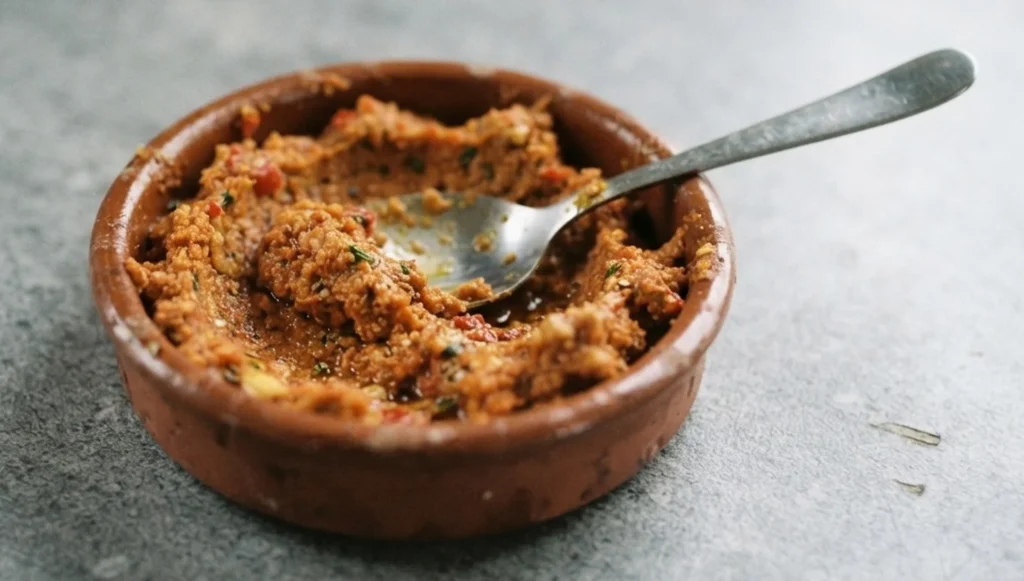
I walked past a couple of bars before one blackboard caught my attention: Pâté de Pimientos del Piquillo y Almendras. I ordered it without particularly knowing what was coming, and what arrived was a small terracotta dish of something bright, rust-coloured, and slightly sweet, with toasted bread and a glass of something cold., rust-coloured, and slightly sweet, with toasted bread and a glass of something cold. A very satisfying light lunch. I drove back to the van and made my own version the same afternoon.
A Note on the Peppers — and the Almonds
I pushed the boat out and bought a jar of Conservas Pedro Luis — a family-run producer specialising in organic, D.O.P.-certified piquillos from Lodosa. Expensive, but the quality is immediately apparent when you open the jar: deep scarlet, firm, intensely flavoured, with none of the watery softness you get from lesser jars. If you can find them, use them. If not, any D.O.P. Piquillo de Lodosa will do the work — just drain well and pat dry if they seem at all wet.
A 200g jar goes further than one ramekin needs. I used half — around 100g — and kept the rest covered in the fridge for a couple of days. Piquillos at that price deserve more than one outing: they're excellent alongside grilled fish, draped over toast with a little cheese, or eaten straight from the jar as a perfectly legitimate van snack.
Marcona almonds are worth a mention too. Shorter, rounder, and sweeter than the standard blanched almond, they're native to Spain — grown mainly in Valencia, Alicante, and Murcia — and widely available here pre-toasted, which is how they earn their place in a no-cook van recipe. Their natural butteriness means they blend into the pâté rather than fighting it, and the flavour sits comfortably alongside the piquillos without either ingredient overpowering the other.
Piquillo Pepper Pâté — The Method
This is as straightforward as it looks. The Marcona almonds give it body and a slightly grainy texture that stops it feeling too smooth. The smoked pimentón reinforces what the peppers already offer. A squeeze of lemon lifts the whole thing without making it sharp.
Drain the peppers well and pat dry if needed. In a small USB blender, combine the peppers, almonds, garlic, lemon juice and pimentón. Blend until you have a rough paste — without a pulse function, a few short bursts with pauses works better than running it continuously, which can take the texture too far. You want a little character left in it, not a smooth purée. Add the olive oil and blend briefly to combine. Season with sea salt and black pepper, taste, and adjust.
It's better made an hour or two ahead and left to settle in the fridge, but there's nothing technically wrong with eating it straight away. The finished piquillo pepper pâté keeps covered in the fridge for three or four days., and unlike the chicken liver pâtés in this collection, it needs no butter seal.
Ingredients:
- Piquillo peppers (100g, drained well — roughly half a 200g jar)
- Pre-toasted Marcona almonds (30g)
- Garlic (1 small clove, peeled)
- Extra virgin olive oil (1–2 tablespoons)
- Lemon juice (½ teaspoon)
- Smoked pimentón (pinch)
- Sea salt and black pepper
Method:
- Drain the piquillo peppers well and pat dry if needed.
- Add the peppers, Marcona almonds, garlic, lemon juice and pimentón to a small blender. Blend in short bursts until you have a rough paste — you want texture, not a smooth purée.
- Add the olive oil and blend briefly to combine — one tablespoon to start, a second if the texture needs it.
- Season with sea salt and black pepper. Taste and adjust.
- Transfer to a small terracotta dish or jar. Serve at room temperature with toasted bread, or cover and refrigerate until needed.
Footnote:
This piquillo pepper pâté is part of my Pâté & Rillettes Recipes collection — a complete collection of homemade French and Spanish pâtés and rillettes. It also features in my Campervan Cooking Recipes, for food that's actually been made on the road.
Find more recipes and food adventures here.
Wonky photos, proper food, genuine adventures — The Flexible Chef