Asida bil-Asal — Libyan Honey and Ghee Dough from a 13th Century Andalusi Cookbook
There is a 13th century cookbook from Al-Andalus — an anonymous Hispano-Muslim manuscript containing around 500 recipes, written when the Moors still ruled much of what is now southern Spain. Among those recipes is an early version of asida: a thick wheat dough cooked in boiling water, served with clarified butter and honey. The dish was already ancient by the time it was written down. The oldest known Arabic recipe for it appears in the 10th century Kitab al-Tabikh — the Book of Dishes — where it is made with wheat flour, clarified butter and mashed dates.
I live thirty-five kilometres from Jaén city, where Arab baths dating from the eleventh century still stand. The kitchen at Casa Adora sits in a landscape shaped by eight centuries of Moorish culture. When I cook asida, I am not cooking a foreign dish. I am cooking something that was cooked here.
Asida bil-Asal — asida with honey — is eaten today across Libya, Yemen, Saudi Arabia and Sudan. It is a celebration dish: made for Eid, for new births, for milestones worth marking. Communal, generous, eaten with the right hand, torn from a shared dome of dough and dipped into a pool of warm honey and ghee. It is as far from a weeknight supper as it is possible to get — and worth every minute of the preparation.
The traditional method requires a mushwat — a flat wooden paddle — and considerable arm strength. I use a stand mixer. The result is identical.
What Is Asida?
Asida (also spelled aseeda) comes from the Arabic root 'asada — to twist or to turn — which describes the labour-intensive process of stirring and kneading flour directly into boiling water until a smooth, elastic dough forms. The word describes both the technique and the dish.
It is not bread. It is not porridge. It is somewhere between the two — a cooked dough with a texture that is simultaneously dense and silky, sticky and elastic. It is meant to be eaten hot, immediately, with the toppings poured over at the table.
The Stand Mixer Adaptation
The traditional method involves dumping flour into boiling water and beating it vigorously with a wooden paddle for twenty minutes. This is genuine physical work. A stand mixer with a dough hook achieves the same result in a fraction of the time and without the risk of a scalded forearm.
The technique is the same — flour into boiling water, vigorous beating until smooth and elastic — but the machine does the work. This is a legitimate adaptation. The dish is unchanged.
Asida bil-Asal — The Recipe
This asida bil-Asal recipe serves 2–3
Ingredients
For the dough:
- 3 cups (375g) plain flour, sifted
- 4 cups (960ml) water
- ½ tsp fine sea salt
- 1 tbsp ghee
For serving:
- ¼ cup (60ml) ghee, warmed
- ½ cup (170g) good honey, warmed — wild honey if you can find it
- Alternative: date syrup (rubb) in place of or alongside the honey
Method
In a large heavy-bottomed pot, combine the water, salt and 1 tbsp ghee. Bring to a rolling boil over high heat. When boiling, carefully ladle out exactly 1 cup (240ml) of the boiling water and set aside in a heatproof jug.
Reduce the heat to its lowest setting. Add all the sifted flour to the pot at once. Remove the pot from the heat immediately and begin beating the mixture vigorously with a heavy wooden spoon, mashing the flour into the water until a thick, rough dough forms and no dry flour remains. This is the hardest part — work quickly before the dough sets unevenly.
Transfer the rough dough to the bowl of a stand mixer fitted with the dough hook. Beat on medium speed for 3–4 minutes until the dough becomes smooth and uniform.
Return the dough to the pot. Flatten it into the bottom. Pour the reserved cup of hot water over and around the dough — do not stir it in. Cover tightly with a lid and cook on the lowest heat for 10 minutes. The steam will cook the flour through completely.
Uncover the pot. The water will have pooled around the dough. Transfer everything back to the stand mixer and beat on medium-high speed for 4–5 minutes, incorporating the water completely. The dough should now be exceptionally smooth, shiny, sticky and elastic — it will pull away from the sides of the bowl cleanly.
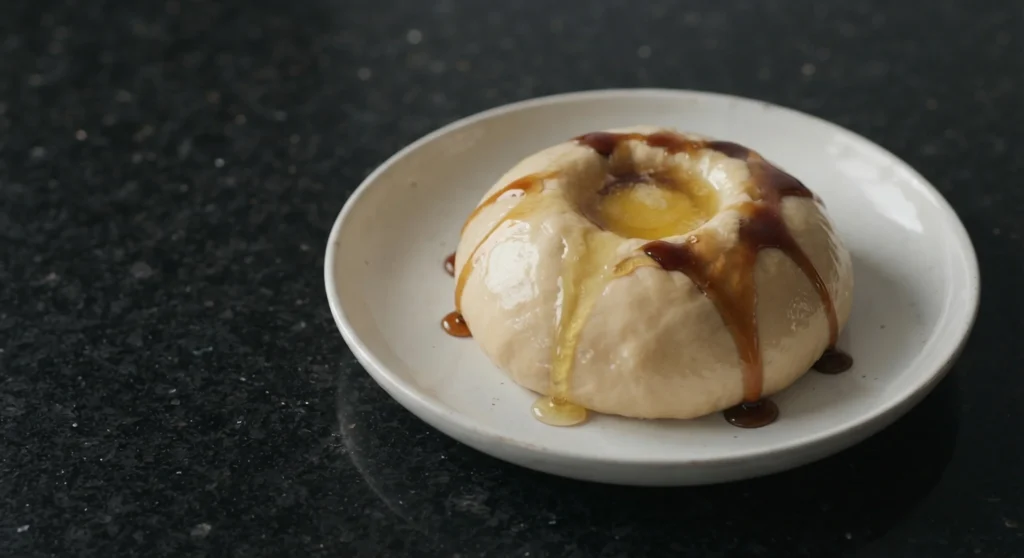
Lightly coat a wide serving bowl or plate with a little ghee. Tip the hot dough into the centre and, with wet hands, smooth it into a neat dome. Using the back of a spoon dipped in ghee, press a deep well into the peak of the dome.
Pour the warm ghee into the well and let it cascade down the sides. Pour the warm honey generously over the top and into the well. Serve immediately.
Traditional etiquette: asida is eaten communally with the right hand. Tear a small piece of dough from the base of the dome, dip it into the pool of honey and ghee at the centre, and eat. No cutlery required.
Notes
Ghee is the authentic fat here — samn, clarified butter, has been used in asida since the Bedouin nomads carried it across the desert. Butter works but ghee is better — it adds a nuttier depth and a higher smoke point that makes the topping richer. Make your own or use a good shop-bought version.
The reserved cup of boiling water is not optional — it is what steams the dough from the inside and removes the raw flour taste. Do not skip this step.
Asida must be served immediately. It sets as it cools and loses its silky texture. Have the honey and ghee warm and ready before the dough comes off the heat.
Date syrup alongside or instead of honey is equally authentic and produces a deeper, more complex sweetness. Both are correct.
Asida bil-asal should be served immediately.
FOOTNOTE
This asida bil-asal recipe is part of my North African Recipes collection — Morocco, Tunisia, Algeria, Libya, Egypt and Sudan, cooked at Casa Adora in rural Andalucía.
It also features in the Cooking Through History collection — where I cook my way through the ancient world. This recipe appears in a 13th century Hispano-Muslim cookbook written in Al-Andalus, thirty-five kilometres from where I am cooking it now.
Find more recipes and food adventures here.
Wonky photos, proper food, genuine adventures – The Flexible Chef