The Arabs who ruled Sicily in the 10th century brought rice and saffron to the island, and from those two ingredients — plus whatever meat and spices were to hand — Sicilian cooks built something entirely their own. Arancini: golden, round, fried rice balls with a ragù hiding inside. The name means little oranges, which tells you everything about the colour you are aiming for.
I have been making stuffed potato balls and meat-stuffed potatoes for a while now, and arancini are the same idea — a filling encased in a starchy shell, breaded and fried until the outside is crisp and the inside is something else entirely. The technique is identical. The result is different enough to be worth making both.
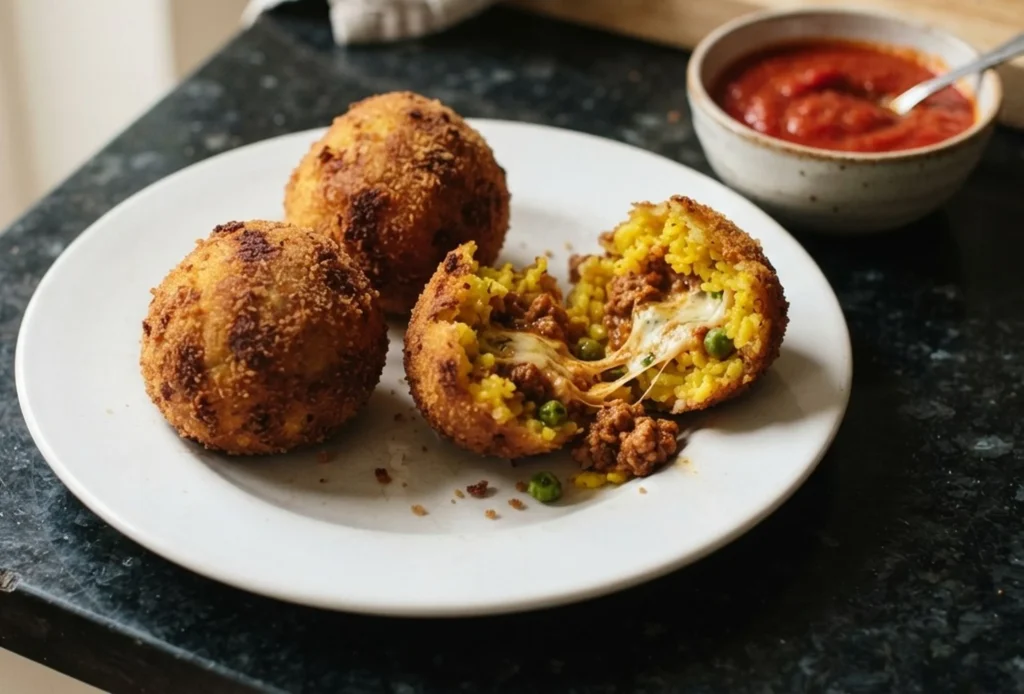
I am cooking this arancini recipe in the kitchen at Casa Adora, in rural Jaén — which is Andalucía, which was Al-Andalus for five centuries, where the same Arab culinary wave left its own marks on the food. Rice, saffron, almonds — the thread runs through this kitchen whether I am making paella or arancini. Six of them: three tonight, three in the freezer.
From Arab Sicily to the Streets — A Brief History of Arancini
When Arab rulers arrived in Sicily in the 9th and 10th centuries, they brought with them a culinary repertoire that transformed the island's cooking — rice, saffron, citrus, sugar, spices. The combination of rice with saffron and savoury meat fillings is almost certainly an Arab innovation, adapted by Sicilian cooks into something portable, practical, and deeply satisfying.
By the 11th century arancini had become street food. By the 17th century they were tied to the calendar: in 1646, during a severe famine, the people of Catania prayed to Saint Lucy — Santa Lucia — for deliverance. When ships carrying grain arrived on her feast day, 13 December, the city celebrated by eating arancini and other foods that required no grinding of wheat. The tradition continues today.
The first formal documented recipes appeared in Sicilian cookbooks in the 19th century, by which point arancini were already deeply embedded in the culture — and already the subject of argument. Western Sicily, centred on Palermo, calls them arancine: feminine, round, like the oranges they resemble. Eastern Sicily, centred on Catania, calls them arancini: masculine, often conical in shape. Both sides are right. Neither will concede.
The Rice — Why Arborio or Carnaroli
Arancini need a rice with enough starch to hold its shape when cold and pressed — and that means a medium-grain Italian variety — and the right foundation for any good arancini recipe. Arborio or carnaroli are the right choices, the same rice you would use for risotto. The starch that makes risotto creamy is what gives arancini their structure. For a full guide to rice varieties and which to use when, see Types of Rice — A Cook's Guide to Every Variety. And if you want to understand what that same rice does in a different context, Risotto: It is all in the stock is worth reading first. and that means a medium-grain Italian variety.
Arancini Recipe — Sicilian Fried Rice Balls al Ragù
Makes 6 | Saucepan + deep pot | Prep 30 mins + cooling | Cook 45 mins | Total approx 2 hours
For the Rice
- 150g arborio or carnaroli rice
- 600ml chicken or vegetable stock
- ¼ tsp saffron threads, steeped in 2 tbsp warm water
- 15g unsalted butter
- 30g Parmigiano-Reggiano, finely grated
- Sea salt to taste
For the Ragù
- 150g beef mince
- ½ small onion, finely diced
- 75g frozen peas, defrosted
- 200ml passata
- 1 tbsp tomato paste
- 75ml dry red wine
- 1 tbsp olive oil
- 75g mozzarella, cut into small cubes
- Sea salt and black pepper
For the Breading
- 60g plain flour
- 90ml cold water
- 100g fine breadcrumbs
- Sunflower oil for deep frying
Method
The Rice
- Bring the stock to a simmer. Add the rice and a pinch of sea salt. Cook on low, stirring occasionally, until the liquid is fully absorbed — 15–18 minutes.
- Stir in the butter, Parmigiano-Reggiano and saffron water. Taste for salt.
- Spread onto a tray and leave to cool completely — at least 1 hour. The rice must be cold and firm before shaping.
The Ragù
4. Heat the olive oil in a saucepan over medium heat. Soften the onion for 5–6 minutes.
5. Add the beef mince and brown thoroughly, breaking it up as it cooks.
6. Pour in the wine and let it evaporate — 2–3 minutes.
7. Add the tomato paste, stir for 1 minute, then add the passata and peas. Season with sea salt and black pepper.
8. Simmer on low for 20 minutes until thick and almost dry. Cool completely.
Assembly
9. Wet your hands. Scoop roughly 80g of cold rice into your palm and flatten it.
10. Make a well in the centre. Add 1 tablespoon of ragù and 2–3 cubes of mozzarella.
11. Fold the rice over the filling and shape into a firm ball. Repeat to make 6.
Breading & Frying
12. Whisk the flour and water to a smooth thin batter.
13. Dip each ball in the batter, then roll in breadcrumbs until fully coated.
14. Heat sunflower oil to 175°C in a deep pot. Fry in batches of 2–3 for 4–5 minutes until deep golden brown.
15. Drain on kitchen paper. Serve immediately.
Recipe Notes
- The rice must be completely cold before shaping — this is the most important step in any arancini recipe.
- The ragù must be thick and almost dry before you use it — too wet and the arancini collapse during frying.
- Wet your hands before shaping each ball to prevent the rice sticking.
- Fry in small batches to maintain the oil temperature.
- To freeze: bread the arancini before frying, freeze on a tray until solid, then transfer to a bag. Fry from frozen at 160°C for 6–7 minutes.
Serving Suggestions
Arancini are best eaten hot from the oil. This arancini recipe makes six — enough for three tonight and three for the freezer. A simple tomato sauce alongside for dipping is the Sicilian way. If you enjoy this kind of dish — a filling hidden inside a starchy, fried shell — the same technique works with potato: Crispy Baked Papas Rellenas and Meat Stuffed Potatoes — Patatas Rellenas are worth making next.
Footnote
This arancini recipe is part of my Rice Recipes collection — a global collection of rice dishes from paella to pilau.
It also features in my Beef & Veal Recipes collection — slow-cooked, braised and minced beef from Casa Adora and beyond.
Wonky photos, proper food, genuine adventures — The Flexible Chef