Bubble and Squeak — The Great British Leftover Fry
Bubble and squeak is not a recipe you plan. It's what happens on Sunday morning when there are cold potatoes and leftover cabbage in the fridge and you can't think of a single reason not to fry them.
The name comes from the sound — the bubbling and squeaking a hot pan makes when cold wet vegetables hit the butter. It's one of those dishes that tells you exactly what it is before you've even tasted it.
A British Habit with Many Names
Across the British Isles, the habit of frying yesterday's potatoes and vegetables into a hearty breakfast takes different names depending on where you are. In England it's bubble and squeak. In Scotland, leftover stovies are often pressed into a pan and fried until crisp — I do exactly that with Agnes Isabella's stovies, though they rarely survive long enough to see Monday. Wales has its own version in ffrio tatws or tatws mewn padell — if you want to explore Welsh potato cooking further, my Tatws Pum Munud is a good place to start. Ireland doesn't name the dish separately, but colcannon or champ are traditionally fried the following day. In Northern Ireland the same practice sits comfortably alongside slices of fadge or potato bread in the pan.
Different names, same instinct: nothing wasted, everything fried.
It's worth mentioning that Scotland also has Rumbledethumps — mashed potato, cabbage and onion baked under a cheese crust — which sits in a slightly different tradition but belongs to the same family of frugal potato-and-cabbage thinking.
A Brief History of Bubble and Squeak
Bubble and squeak has been around longer than most people realise. The first recorded references in print date to somewhere between 1770 and 1785, and the original dish was nothing like the one we know today. It combined chopped boiled beef with fried cabbage — the beef was the bulk of it, and the cabbage was almost incidental.
The shift to potatoes happened gradually, but the Second World War accelerated it sharply. Meat rationing made beef an occasional luxury rather than a Monday leftover, and potatoes — grown in abundance as part of the Dig for Victory campaign — took its place as the primary ingredient. What had been a meat dish became a vegetable dish almost by necessity.
By the time rationing ended, the potato version had stuck. The beef version effectively disappeared, and bubble and squeak became what it is today: a crisp fried cake of leftover boiled potato and greens, usually cabbage or Brussels sprouts, cooked until properly golden on both sides.
This Bubble and Squeak
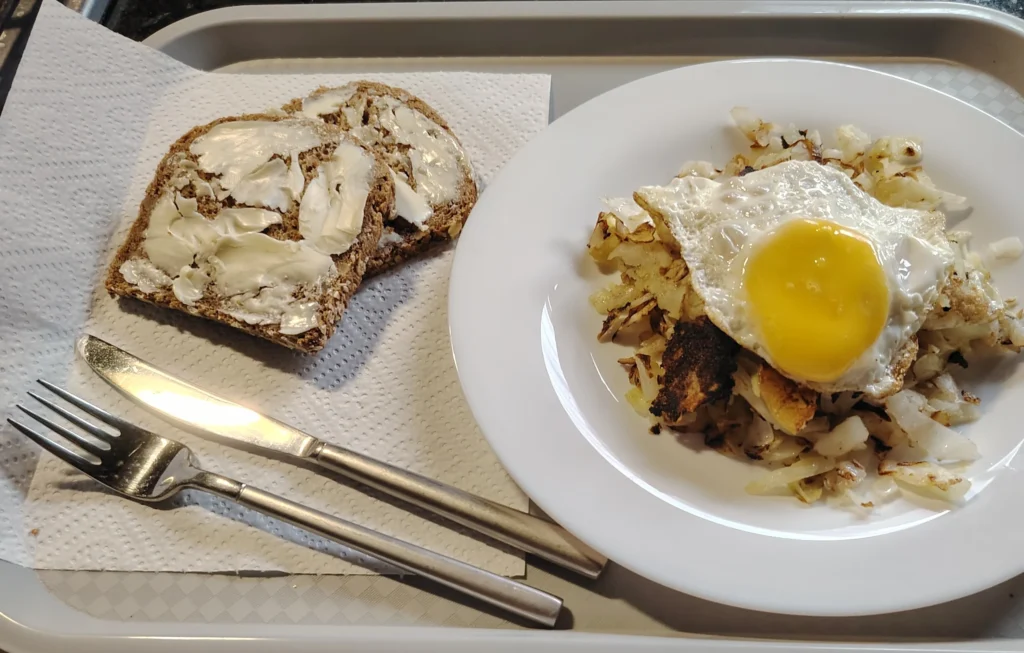
I had 300g of leftovers — roughly 50/50 between cold skin-on new potatoes and cooked white cabbage. That's a slightly higher cabbage ratio than the classic, which traditionally leans potato-heavy. I kept it as it was. More cabbage means more caramelised edges, a lighter result, and a faint sweetness from the white cabbage that works particularly well under a fried egg.
The other small addition is a splash of cider vinegar stirred through just before pressing flat. It's not traditional in the modern sense, but early recipes often included vinegar, and it cuts through the butter and egg richly without announcing itself. Worth doing.
Ingredients
- 150g cooked new potatoes, skin on, roughly crushed
- 150g cooked white cabbage, drained well
- 1 tbsp olive oil
- 15g butter, plus a small knob for the egg
- Splash of cider vinegar
- Sea salt and white pepper
- 1 large egg
- Rustic bread, to serve
Method
Prep the mix
Roughly crush the cold potatoes with a fork — you want uneven chunks, not mash. Mix with the cabbage and season generously with sea salt and white pepper. Add a small splash of cider vinegar and mix through.
Fry
Heat the olive oil and butter together in a frying pan over a medium-high heat. When the butter is foaming, add the potato and cabbage mixture and press it firmly and evenly into the pan with a spatula. Leave it completely alone for 8–10 minutes until a deep golden crust has formed on the underside. Don't stir, don't prod — just leave it.
Flip
Slide the bubble and squeak onto a plate, crust-side up, then invert it back into the pan. Press flat again and cook for a further 5–6 minutes until the second side is equally golden.
The egg
Slide the bubble and squeak onto your serving plate. Add the small knob of butter to the pan, crack in the egg, and fry to your liking — the yolk should still be runny enough to break over the top.
Serve
Place the egg on top of the bubble and squeak. Eat immediately with rustic bread.
Footnote:
This bubble and squeak recipe is featured in my Potato Recipes hub, a collection of proper spuds from the Casa Adora kitchen and the road.
The leftover potatoes in this dish make it a resistant starch recipe — cook it, cool it, use again.
Find more recipes and food adventures here.
Wonky photos, proper food, genuine adventures — The Flexible Chef