Homemade Organic Kefir
Buying kefir grains is easy — online, delivered to my door. Manuel, the postman, always has something to say, and knocks whether he needs to or not. If I'm out he leaves the package in the postbox beside the front door. Organic whole milk, non-UHT, is considerably more of a mission. This homemade kefir recipe needs just two ingredients.
It's available at El Corte Inglés in Jaén — which means parking Florie, a six-metre campervan, in a city centre. That problem is solved by finding a car park without height barriers and accepting that you're going to walk further than you'd like. The real downfall of using the El Corte Inglés food hall is that I go in for milk and come out having spent a fortune. Every time.
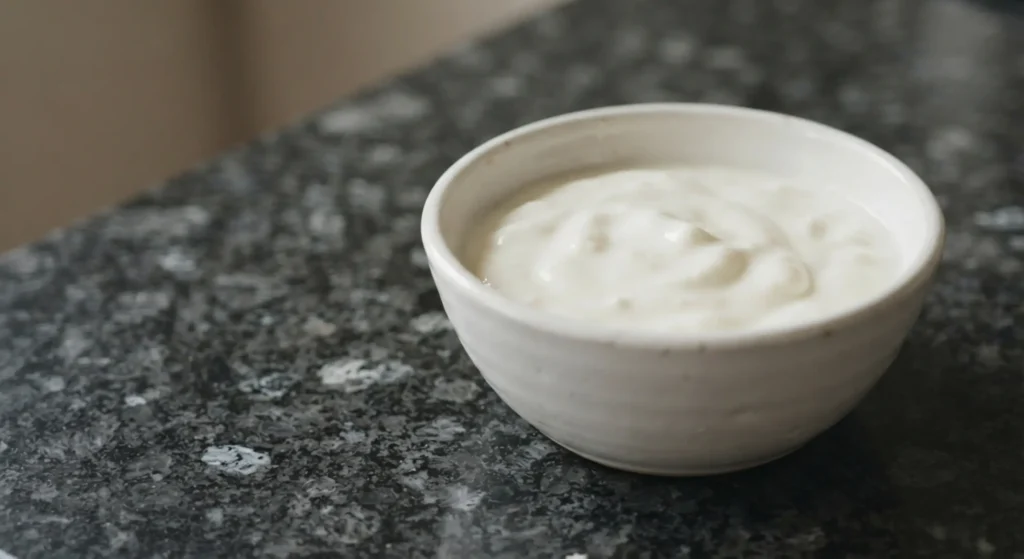
It's worth it. Homemade kefir — made with live grains and good organic milk — is one of the most microbiome-friendly foods you can put in your body. Shop-bought kefir is pasteurised after fermentation, which kills the live cultures. Homemade isn't. That's the difference.
One litre of organic whole milk and one tablespoon of active kefir grains is all you need to get started.
This homemade kefir recipe is as straightforward as fermentation gets — two ingredients, one jar, and eighteen to twenty-four hours of patience. If you are new to kefir grains milk fermentation, this is the place to start. The grains do the work; your job is to stay out of the way.
If you're wondering how kefir fits alongside other fermented foods and the question of histamine intolerance symptoms, my Histamine Intolerance Symptoms — A Chef's Take on Fermented Foods covers exactly that — including why fermented foods are not the enemy.
How to Make Kefir at Home
What You'll Need
- 1 litre organic whole milk — not UHT, not ultra-pasteurised; lightly pasteurised or raw if you can get it
- 1 tbsp active milk kefir grains
- 1.5 litre glass mason jar
- Breathable cloth or coffee filter and a rubber band
- Stainless steel fine-mesh sieve
- Wooden spoon
- Clean glass bottle for storing
Method
Place your kefir grains directly into the bottom of the clean glass jar. Pour the organic milk over the grains, leaving roughly 5cm of headspace at the top to allow room for fermentation gases to expand. Give it a gentle stir with the wooden spoon.
Cover the mouth of the jar with the breathable cloth or coffee filter and secure it tightly with the rubber band. This lets gas escape while keeping out fruit flies and dust. Place the jar on your kitchen counter away from direct sunlight.
Leave it to ferment at room temperature — ideally between 20°C and 24°C — for 18 to 24 hours.
What to Look For
The kefir is ready when the milk thickens slightly and smells pleasantly tart and fresh. If you see small pockets of yellowish liquid — whey — beginning to separate near the bottom, it's fully fermented and ready to strain.
Straining
Give the jar a quick stir. Set the sieve over a clean bowl or jug and pour the fermented kefir through it. Use the wooden spoon to gently agitate the mixture so the thick liquid passes through, leaving the rubbery, cauliflower-like kefir grains behind in the sieve.
Pour the strained kefir into your glass bottle, seal it, and refrigerate. It tastes best thoroughly chilled and keeps for up to two weeks.
Looking After Your Grains
Do not wash or rinse the kefir grains after straining. Transfer them straight back into the jar, pour in fresh organic milk, and start the next batch.
If you need a break from brewing, place the grains in a small jar, submerge them completely in fresh milk, seal with a solid lid, and store in the fridge. This puts the grains to sleep for up to a week.
The beauty of this homemade kefir recipe is that the grains keep going indefinitely — one purchase, endless batches.
A Note on Equipment
Avoid aluminium and copper bowls and utensils. The acidity of fermenting kefir reacts with reactive metals and can damage the culture. Stainless steel or wood throughout — nothing reactive.
Adjusting the Flavour
If your kefir tastes too sour or separates too quickly, your room temperature may be on the warm side — not an unusual problem in an Andalucían kitchen in August. Reduce the fermentation time to 12–15 hours, or increase the volume of milk slightly to slow things down.
Footnote
This homemade kefir recipe is part of my Gut Health Recipes collection — real food from a rural Andalucían kitchen, built around fermented foods, high-fibre pulses, wholegrains and prebiotic-rich ingredients. It also features in the Fermentation Hub and my Veggie & Vegan collections — the full range of lacto-fermented, cultured and plant-forward recipes from Casa Adora.
All recipe hubs → Recipe Hubs
Find more recipes and food adventures here.
Wonky photos, proper food, genuine adventures — The Flexible Chef