Scottish Stovies — Agnes Isabella's Monday Plate
I have looked at a lot of stovies recipes. None of them are right.
That's not a criticism. It's just that what I remember from 10 Mill Street, Montrose, in the early 1960s bears little resemblance to what most recipes produce. Agnes Isabella made Scottish stovies on Mondays from Sunday's brisket— no meat in the dish itself, just potatoes on the verge of collapse, sliced carrots soft enough to crush between tongue and palate, and a dark, almost sticky gravy built from beef dripping and reduced stock. That's it. That's the whole thing.
What passes for stovies now tends to be a more constructed affair — deliberately cooked rather than descended from leftovers, often containing meat, sometimes onion, occasionally tinned corned beef. I'm sure they're good. They're not what I had.
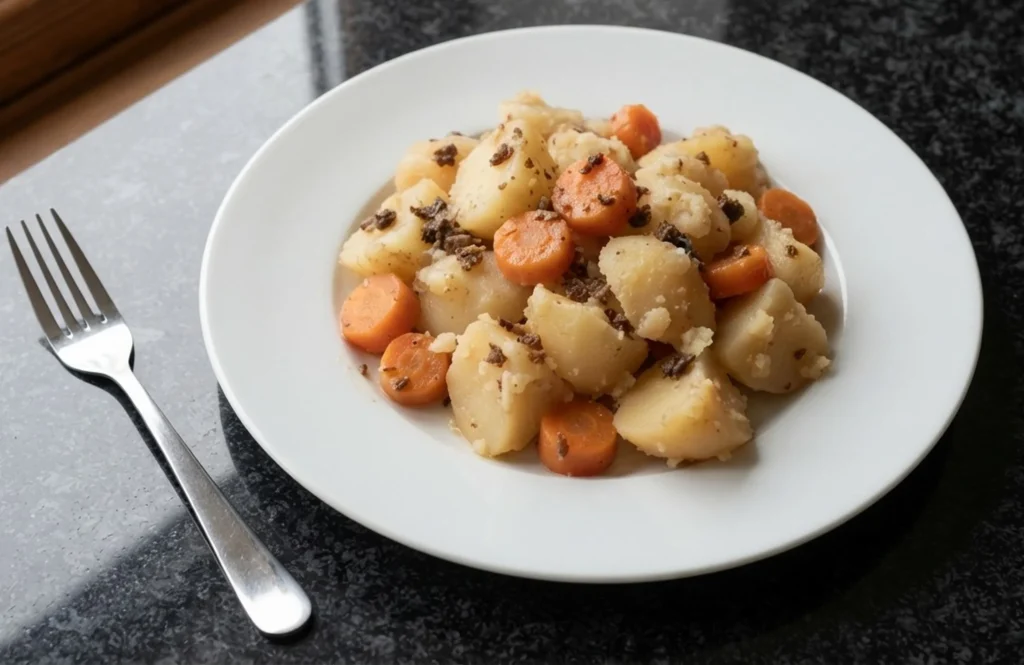
This is my attempt to reconstruct Agnes Isabella's version from sixty-year-old sense memory, with the ingredients available to me in rural Andalucía. It is an honest approximation. It is not the real thing — because the real thing can't be separated from a Sunday brisket roast, and a brisket roast is not a practical proposition when you're cooking for one.
What Are Scottish Stovies?
Scottish stovies take their name from the Scots word stove — to cook slowly in a covered pan. The dish itself is Monday food: a way of using Sunday's roasting fat and leftover potatoes to make something that, in skilled hands, became better than what came before it.
Agnes Isabella roasted brisket on Sundays. Three courses at lunch, two at dinner — she cooked in service and brought that discipline home. The brisket sat on a rack over a tin of root vegetables and stock, and for hours the fat and juices dripped down through it, slowly reducing into something dark and complex at the bottom of the tin. By the time the brisket came out, what remained in the tin wasn't just dripping — it was dripping infused with everything that had fallen from the meat during a long, slow roast.
That liquid, scraped from the tin and combined with the set dripping, was what went into Monday's stovies. It's why they tasted the way they did. And it's why no recipe I've found since has quite matched what I remember — because most stovies start from neutral stock, and Agnes Isabella's started from something already deeply reduced and complex before Monday even arrived.
There was no onion in her version. There was no meat. The brisket had done its job on Sunday. What remained was the flavour — concentrated in the dripping, carried in the stock, coating everything by the time it reached the table in a dark, sticky reduction.
The Casa Adora Version — An Honest Approximation
I cannot roast a brisket for one. I'd be eating it all week. So this version builds the dark, reduced base that Agnes Isabella's tin produced, using what's practical at Casa Adora.
My butcher gives me beef fat for free when I'm buying other cuts. I render it slowly at home until the fat runs clear and the solids turn golden. What comes out is proper beef dripping — the foundation any honest stovies recipe needs — and it keeps in the fridge for weeks.
For the stock, I roast a small piece of beef on a rack over root vegetables and a little stock, replicating Agnes Isabella's Sunday tin on a scale that makes sense for one. The resulting liquid is darker and more complex than plain beef stock.
If you have access to a proper Sunday roast — the rack, the tin, the long slow cook — use it. Save everything in that tin. That's the dish Agnes Isabella made. This is the rest of us doing our best.
Ingredients
(Serves 1, generously)
- 400g floury potatoes, peeled and sliced into rounds roughly 1cm thick (Agria works well in Spain)
- 2 medium carrots (zanahorias), peeled and sliced into rounds
- 2 tbsp beef dripping, rendered at home or from a good source
- 300ml dark beef stock — reduced, roasting-tin stock if you have it; see note above
- Sea salt and white pepper
Method
1. Render the dripping (if starting from fat)
Cut the beef fat into rough pieces and place in a heavy pan over a low heat. Cook slowly until the fat has melted and the solids are golden. Strain through a fine sieve. You need 2 tablespoons for this recipe — the rest keeps refrigerated.
2. Build the base
Melt the dripping in a heavy-based pan over a medium-low heat. Add the potatoes and carrots and turn them in the fat until well coated. Pour in the stock — it should come roughly halfway up the potatoes. Season with salt and white pepper.
3. Cook low and slow
Cover tightly and cook over the lowest heat you can manage for 45 minutes to an hour, checking occasionally. The potatoes should be absorbing the stock and beginning to break down at the edges. The carrots will soften completely — that's correct, not a problem to be avoided. If the liquid reduces too quickly, add a splash more stock or water.
4. Reduce to sticky
Remove the lid for the final 10–15 minutes and allow the remaining liquid to reduce until it coats everything in a dark, glossy gravy. Don't rush this and don't walk away from it. This is the moment the dish becomes itself.
5. Serve
Straight from the pan into a deep plate. Nothing alongside. A thick slice of bread if you have it.
Chef's Notes
Agria is my go-to potato in Spain for anything that needs to break down without disappearing entirely. Edzell Blue would have been Agnes Isabella's variety — a Scottish heritage potato with skin the colour of a bruise and a delicate flavour not available here. Agria is the closest practical substitute.
White pepper rather than black — it was standard in Scottish kitchens of that era, and it sits differently in the dish.
The stock matters more than anything else here. A weak stock produces a thin, pale result that won't reduce to anything worth eating. Use a good one, or reduce a lighter stock hard before you start.
There was no onion in Agnes Isabella's stovies. I've made versions with onion. They're fine. They're a different dish.
This beef dripping potato dish doesn't need much. It needs the right fat, the right stock, and enough time.
Do not attempt this with olive oil. The flavour is entirely wrong and Agnes Isabella would know.
One thing has always been missing from this recipe. My sister solved it on a sentimental journey to Montrose — a photograph of a packet of Comptons Gravy Salt and a single line:
'This is why your stovies don't taste like Granny Morrison's. X'
She was right. The solution is Nearly Comptons Gravy Salt — a homemade version of the Scottish cupboard staple that gives stovies their particular depth and colour. Make it first.
This Scottish stovies recipe is featured in my Scottish Recipes hub and my Potato Recipes collection — traditional and adapted Scottish dishes, and everything worth doing with a good potato. It also features in my Gut Health Recipes collection — real food from a rural Andalucían kitchen, built around fermented foods, high-fibre pulses, wholegrains and prebiotic-rich ingredients. And it's part of From the Family Kitchen — Agnes Isabella's recipes and family cooking from Rochdale, Gran Alacant and beyond.
The leftover potatoes in this dish make it a resistant starch recipe — cook it, cool it, use again.
Find more recipes and food adventures here.
Wonky photos, proper food, genuine adventures — The Flexible Chef