Al-Sikbaj — A Medieval Andalusi Lamb Stew from the Court of Cordoba
In the 9th century, a musician and polymath named Ziryab travelled from Baghdad to the Umayyad court in Cordoba. He brought with him eastern tastes, culinary styles, and recipes — among them al-sikbaj, a sweet-and-sour meat stew that had already been cooking in Persian and Baghdad kitchens for centuries. At the Cordoban court, it became one of the most celebrated dishes in Al-Andalus. In the 13th century, it appeared in the anonymous Hispano-Muslim cookbook — the same manuscript that contains the earliest Andalusi recipe for asida. This al-sikbaj recipe is my version of that court dish.
Over the following centuries, as the Reconquista pushed the Moors out of Iberia, al-sikbaj evolved. The heavy meat stew adapted into a cold pickled fish dish — escabeche — retaining the core vinegar-preservation method of the original while losing the spices, the dried fruit, the almonds and the saffron that made the medieval version extraordinary. Escabeche is still made across Spain today. The dish it came from is almost forgotten.
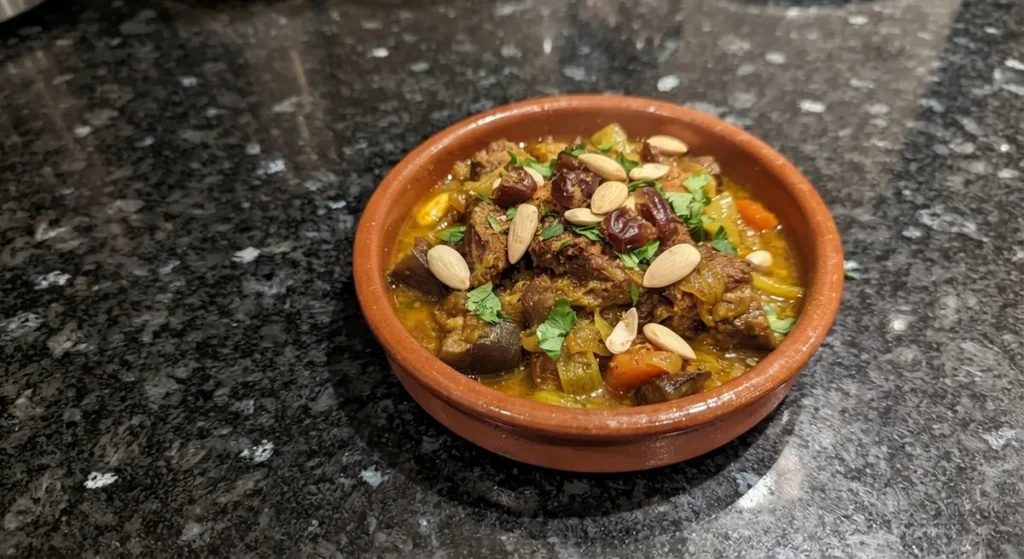
I live thirty-five kilometres from Cordoba's spiritual successor in this province — Jaén city, where Arab baths dating from the eleventh century still stand. When I cook this al-sikbaj recipe at Casa Adora, I am cooking a dish that was cooked in this landscape at the height of its civilisation.
What Is Al-Sikbaj?
Al-sikbaj is a medieval Andalusi recipe for a sweet-and-sour braised meat stew — the sweet from honey, the sour from vinegar, the complexity from a layered medieval spice blend that includes coriander, cinnamon, long pepper and the warm, resinous notes of spices that were luxury goods in 13th century Andalucía. Aubergine, onion, leek and carrot form the vegetable base. Saffron gives the sauce its golden colour. Blanched almonds and dates are scattered over at serving.
It is not a quick dish. It is a dish that rewards patience and attention — which is, in the medieval Arab culinary tradition, exactly the point. A meal worth eating was a meal worth making properly.
A Note on the Spices
The authentic high-court al-sikbaj uses Grains of Paradise and Cubeb pepper alongside long pepper and coriander — rare medieval spices that are increasingly available from specialist retailers online. I have substituted both in this al-sikbaj recipe: black pepper and a pinch of cardamom for Grains of Paradise; black pepper, a tiny pinch of clove and a touch of nutmeg for Cubeb. The substitutions are reasonable approximations. When the authentic spices arrive, this recipe will be cooked again.
I do have long pepper — hotter and sweeter than black pepper, with a faintly floral quality that is irreplaceable. Use it if you can find it.
Al-Sikbaj Recipe
Serves 1
Ingredients
For the lamb:
- 250–300g lamb shoulder, cut into bite-sized pieces
- 500ml water, for initial boiling
- 1 tsp fine sea salt
For the sweet-and-sour base:
- 2 tbsp white wine vinegar
- 1 tbsp honey
- 1 tbsp olive oil
For the vegetables:
- 1 small onion, finely sliced
- ½ leek, sliced
- ½ small aubergine, peeled, quartered and pricked with a fork
- 1 medium carrot, sliced
Medieval spice blend:
- ½ tsp ground coriander
- ¼ tsp ground cinnamon
- ¼ tsp long pepper, ground (or black pepper)
- ¼ tsp black pepper
- Pinch of cardamom (for Grains of Paradise)
- Tiny pinch of ground clove (for Cubeb pepper)
- Tiny pinch of ground nutmeg (for Cubeb pepper)
- Good pinch of saffron, soaked in 2 tbsp hot water
For the garnish:
- Small handful blanched almonds
- 3–4 dried dates, roughly chopped
- Fresh coriander, to finish
Method
Place the lamb pieces in a pot with the water and salt. Bring to the boil and skim off any foam that rises to the surface. Simmer for 20 minutes, skimming regularly. This initial boiling and skimming is a medieval technique — it clarifies the broth and removes impurities. Lift the lamb out and set aside. Reserve the broth.
Heat the olive oil in a heavy pan over a medium heat. Add the onion and leek and cook gently for five minutes until softened. Add the aubergine and carrot and cook for a further five minutes.
Add the entire spice blend and stir through for one minute until fragrant. Add the lamb pieces and stir to coat in the spiced vegetable base.
Combine the white wine vinegar and honey in a small bowl and stir until the honey dissolves. Pour over the lamb and vegetables. Add the saffron and its soaking water. Add enough of the reserved lamb broth to just cover everything.
Bring to a gentle simmer, cover, and cook on a low heat for 45–50 minutes until the lamb is tender and the sauce has reduced to a thick, glossy, sweet-sour glaze. Check and stir occasionally — the honey can catch on the base of the pan.
Taste and adjust — more honey for sweetness, more vinegar for sharpness. The balance should be distinctive but not extreme in either direction.
Serve in a wide bowl. Scatter the blanched almonds and chopped dates over the top. Finish with fresh coriander. Eat immediately.
Notes
The aubergine was highly celebrated in Al-Andalus — the Moors introduced it to Iberia and it appears throughout the Hispano-Muslim manuscript. Prick it before cooking to allow the spiced broth to penetrate.
Long pepper is worth seeking out for this al-sikbaj recipe specifically. It is available online from specialist spice retailers and has a flavour — hotter than black pepper, with a faintly sweet and floral quality — that cannot be replicated.
The dish that al-sikbaj became — escabeche — is still made across Spain today. The vinegar is the through-line. Everything else was lost in translation.
If you've enjoyed the recipes, you can buy me a coffee ☕ — it helps keep the site going.
This al-sikbaj recipe is one of my Al-Andalus recipes, part of the Al-Andalus section of my Cooking Through History collection — where I cook my way through the ancient world. This dish was cooked at the Umayyad court in Cordoba in the 9th century and appeared in a 13th century Hispano-Muslim cookbook written in Al-Andalus. Libya still cooks the descendants of this kitchen, so try Sharba Libiya, the Libyan national soup, and Asida bil-Asal, the honey and ghee dough.
You'll also find it in the Moorish Kitchen section of my North African Recipes collection and in my Lamb & Goat Recipes collection.
Find more recipes and food adventures here.
Wonky photos, proper food, genuine adventures — The Flexible Chef