Sharba Libiya — The Libyan National Soup
Sharba Libiya is widely considered the national dish of Libya. Aren't they all?
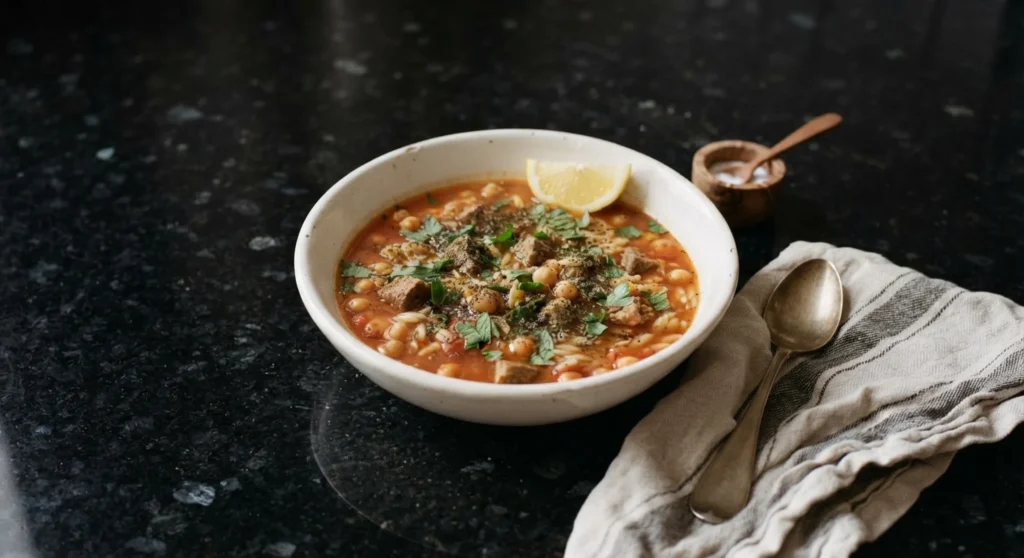
Sharba translates simply as soup in the Libyan dialect. This particular soup is a brothy, one-pot meal of cubed lamb, chickpeas and orzo in a rich tomato and olive oil base, spiced with turmeric, paprika and cayenne, finished with a distinctive scattering of dried ground mint and a lemon wedge on the side. It is comfort food of the highest order — warm, aromatic, deeply satisfying.
It is also, if you follow the culinary thread back far enough, a dish whose ancestry begins in the landscape outside my window.
The Andalusian Thread
In 1247, a scholar named Ibn Razīn al-Tujībī fled Murcia as the Reconquista closed in. By 1259 he was in Tunis, and it was there, in exile, that he compiled Fidalat al-Khiwan — one of only two cookbooks to survive from medieval Al-Andalus, containing 475 recipes from his Andalusian heritage. The book is not just a cookbook. It is an act of preservation — a record of a culinary civilisation being carried out of Iberia in the memory and hands of the people who built it.
Ibn Razīn al-Tujībī was one of thousands. When the Muslim and Jewish populations were expelled from the Iberian Peninsula across the 13th, 14th and 15th centuries, they brought with them agricultural knowledge, culinary techniques, and recipes refined over five centuries of Moorish Iberia. They settled across North Africa — in Morocco, Algeria, Tunisia, Libya — and what they brought blended into local food cultures that were already ancient.
The spiced, grain-and-meat broth eaten across North Africa to break the Ramadan fast — the broad family of soups that includes Moroccan Harira, Tunisian Harira, and Sharba Libiya — reflects that layered history. Berber foundations. Arab spicing. Andalusian refinement. Centuries of local adaptation. And underneath it all, the ghost of a cuisine that once flourished two hundred kilometres north of Casablanca, across the water, in the country I now call home.
I live thirty-five kilometres from Jaén — a city whose Arab baths date from the eleventh century, whose streets still carry Arabic place names, whose olive groves were shaped by Moorish agricultural practice. When I cook Sharba Libiya at Casa Adora, I am making a dish whose culinary ancestry begins in this landscape. That is not a romantic notion. It is history.
Sharba Libiya and Its Cousins
Sharba Libiya sits within a wider North African family of Ramadan soups, each adapted by climate, local ingredients, and regional taste. The differences are illuminating:
| Moroccan Harira | Tunisian Harira | Sharba Libiya | |
|---|---|---|---|
| Base | Thick tomato, flour-thickened | Semolina or chickpea paste | Brothy tomato, not thickened |
| Spices | Ginger, cinnamon, coriander, cilantro | Caraway-forward | Turmeric, paprika, cayenne |
| Grains/Pasta | Lentils, vermicelli | Fine pasta or semolina | Orzo (lisan asfour) |
| Signature | Dense, heavily spiced | Caraway note | Dried mint finish, fiery |
Sharba Libiya is the lightest of the three — brothy rather than velvety, leaning into heat and the distinctive finish of dried mint rather than aromatic depth. The mint is not optional. It is the dish.
A Note on the Tomatoes
Like Al-Sikbaj and Asida bil-Asal, Sharba Libiya contains ingredients that arrived in the Old World after the fall of Al-Andalus — tomatoes and chillies are both New World, post-Columbian. The concept of a rich, spiced grain-and-meat broth used to break the fast is the ancient inheritance. The tomato base is the modern iteration of that tradition. Both things are true, and neither cancels the other.
The Recipe
This is Sharba Libiya for one — a generous, deeply flavoured bowlful with enough body to stand alone. Use orzo rather than fideo here; orzo holds its shape better in a brothy soup and doesn't drink the liquid if you're slow to eat. The dried mint goes on at the end, over the top, as a finishing layer rather than a cooked spice. Don't skip it.
If you have Bzaar in the store cupboard — Libya's own spice blend of turmeric, caraway, coriander and baharat — a pinch alongside the paprika adds a quiet depth that ties the dish back to its Libyan roots.
INGREDIENTS
- 200g lamb shoulder, cut into 2cm cubes
- 1 small onion, finely diced
- 2 garlic cloves, minced
- 1 tbsp olive oil
- 1 tbsp tomato purée
- 200ml passata or 2 ripe tomatoes, blended
- 400ml lamb or chicken stock
- 100g tinned chickpeas, drained
- 50g orzo
- 1 tsp turmeric
- 1 tsp sweet paprika
- ¼–½ tsp cayenne (to taste)
- Salt and black pepper
- Small handful flat-leaf parsley, roughly chopped
- 1 tsp dried ground mint (for finishing)
- Lemon wedge, to serve
- Pinch of Bzaar (optional — see note)
METHOD
Brown the lamb. Season the lamb cubes with salt and pepper. Heat the olive oil in a medium saucepan over high heat and brown the lamb in batches — don't crowd the pan. Set aside.
Build the base. Reduce the heat to medium. In the same pan, soften the onion for five minutes, then add the garlic and cook for another minute. Add the tomato purée and stir for a minute until it darkens slightly. Add the turmeric, paprika, cayenne and Bzaar if using, and stir everything together.
Add the liquids. Return the lamb to the pan. Add the passata and stock, stir well, and bring to a simmer. Cover and cook on a low heat for 40 minutes, until the lamb is beginning to tender.
Add chickpeas and orzo. Add the drained chickpeas and the orzo. Cook uncovered for a further 12–15 minutes, stirring occasionally, until the orzo is just cooked and the soup has thickened slightly. Add a splash more stock or water if it tightens too much.
Finish. Check the seasoning. Stir through most of the parsley. Ladle into a deep bowl, scatter the remaining parsley over the top, and finish with the dried ground mint — a generous pinch, directly over the surface. Serve with a lemon wedge and bread.
This Sharba Libiya recipe features in my North African Recipes collection — recipes from Morocco, Tunisia, Algeria, Libya, Egypt and Sudan, connected by the Moorish thread that runs through Andalucía and across the Mediterranean.
It also sits in my Cooking Through History hub, alongside Al-Sikbaj and Asida bil-Asal — the Al-Andalus strand of the series.
Find more recipes and food adventures here.
Wonky photos, proper food, genuine adventures – The Flexible Chef