Ancient Egyptian Recipes — Lentil and Onion Stew
Ancient Egypt ran on lentils. From the labourers who built the pyramids to the priests who served the pharaohs, lentils were the everyday staple — cheap, filling, protein-rich, and grown abundantly along the Nile. These are ancient Egyptian recipes in the most literal sense: not reconstructed from a single source, but drawn from the accumulated evidence of four thousand years of Egyptian food culture. This is the dish that fed a civilisation.
The koshari connection is impossible to ignore. Koshari — lentils, onions, garlic, cumin, served on street corners across Cairo — is still Egypt's national dish today. The ingredients are almost identical to what ancient Egyptians were eating. The continuity is real, unbroken, and worth pausing on before you start cooking.
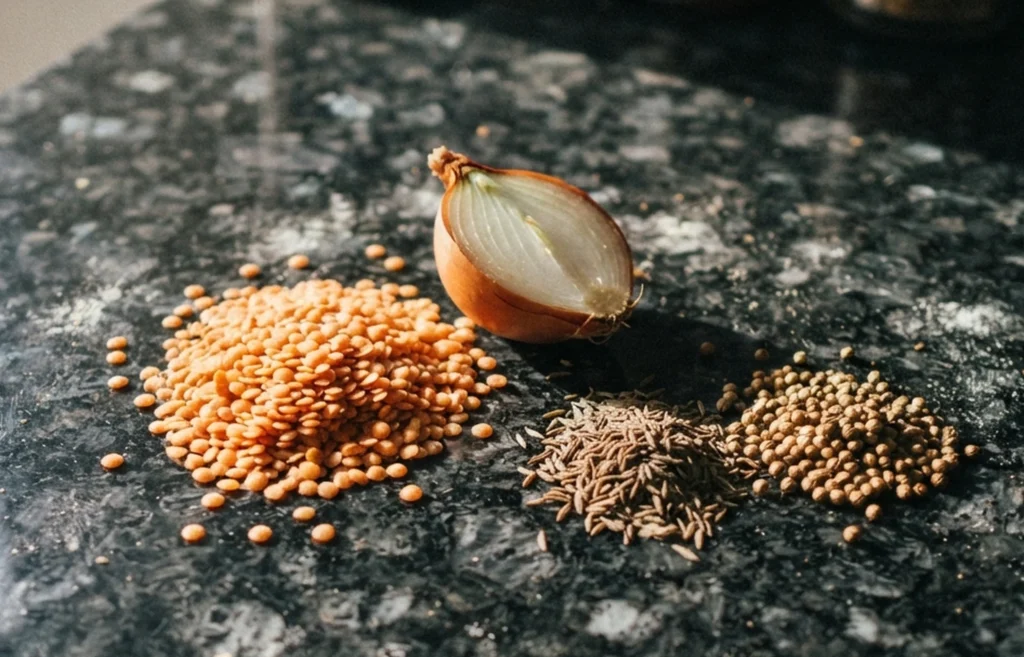
The flexible angle here is honest rather than dramatic. Olive oil for the base — period-appropriate, and the right fat for this dish. Spinach added late, which bulks it out without complicating it. Lemon juice at the end to brighten everything. And a splodge of tomato purée, which is not ancient Egyptian — tomatoes are a New World ingredient that wouldn't reach Egypt for another three thousand years. But the dish needed it, and the flexible angle has always been about cooking that works rather than cooking that's merely correct. Consider it declared.
The crispy fried onions on top are the moment where ancient Egypt and modern koshari meet in the same bowl. In Egypt today they're called dakka — spooned over the finished dish with vinegar and chilli. Here they're simpler: one onion, sliced thin, fried slowly in olive oil until golden and beginning to catch. That's enough.
Ancient Egyptian Recipes — Lentil and Onion Stew
Ingredients
- 2 tbsp olive oil
- 2 medium onions, finely sliced
- 3 garlic cloves, crushed
- 1 tsp cumin
- 1 tsp ground coriander
- 1 tbsp tomato purée
- 150g red/orange split lentils
- 600ml water
- Large handful of fresh spinach
- Juice of half a lemon
- Sea salt to taste
Method
- Heat 1 tbsp of the olive oil in a heavy pot over medium heat. Add one of the sliced onions and cook slowly, stirring regularly, until soft and beginning to turn golden — around 15 minutes. Don't rush this; the sweetness of the onion is the flavour base.
- Add the garlic, cumin, and ground coriander and stir for a minute until fragrant.
- Add the tomato purée and stir through for another minute.
- Add the lentils and water. Stir well, bring to the boil, then reduce the heat to low. Simmer uncovered for 25–30 minutes, stirring regularly — particularly in the last 10 minutes — until the lentils have completely broken down and the stew is thick. Add a little more water if it catches.
- While the stew simmers, heat the remaining tbsp of olive oil in a small frying pan over medium heat. Add the second sliced onion and fry slowly until golden, crispy and beginning to catch at the edges — around 20 minutes. Set aside.
- Stir the spinach through the stew and cook for 2 minutes until wilted. Add the lemon juice and sea salt to taste.
- Ladle into bowls, top with the crispy onions, and serve with spelt flatbread.
Closing:
These ancient Egyptian recipes haven't strayed far — koshari is still Egypt's national dish today — lentils, onions, cumin, garlic, served on street corners across Cairo. The ingredients have barely moved in four thousand years. The tomato purée is mine. Everything else belonged to them first.
Footnote:
This ancient Egyptian lentil stew is featured in my Cooking Through History hub, where I cook my way through the ancient world — from Mesopotamian flatbreads to Medieval English pottage.
You'll also find it in my Veg, Fruit & Pulses hub, my Soup Recipes hub, and my Gut Health Recipes collection — real food from a rural Andalucían kitchen, built around fermented foods, high-fibre pulses, wholegrains and prebiotic-rich ingredients.
This recipe is also part of my North African Recipes — From the Moorish Kitchen at Casa Adora.
Find more recipes and food adventures here.
Wonky photos, proper food, genuine adventures – The Flexible Chef