Bún bò Huế — the soup I ordered by accident
It was February and I was wearing shorts. This seemed like a reasonable decision at the time — Vietnam, after all — but nobody had mentioned that February is winter, and Hanoi in winter is genuinely cold. Not European cold, but cold enough that a backpacker in shorts feels every bit of it. I'd come to Vietnam chasing phở, and I'd found it — but it was a bún bò Huế recipe, Vietnam's spicy beef noodle soup, that I'd eventually carry home, from a city I hadn't known was the gastronomic capital of the country.
We ducked into what turned out to be a working man's café to escape the chill — two large garages with the shutters pulled up, the kitchen visible at the back, rows and rows of communal wooden tables packed tightly with people who all appeared to know exactly what they were doing. We did not. There was something approaching a menu, in the sense that there were two options: phở with meat, or phở with fish. We studied the fish on the display counter. We chose meat. The meat, when it arrived, was equally unrecognisable. It didn't matter. The broth was hot, deeply savoury, and we ate every last drop.
We washed it down with bia hơi — Vietnam's famous fresh beer, brewed daily and delivered every morning by motorbike in steel kegs to bars and cafés across the city. Light, cold, and cheap enough to make your eyes water. Unpasteurised and preservative-free, it has a shelf life of roughly one day — anything left at closing time gets tipped away. Like the bánh mì baguette and phở itself, bia hơi traces its origins to French colonialism: the first brewery in Hanoi was built by the French in the 1890s, and the Vietnamese took it, lightened it, made it entirely their own, and turned it into one of the great simple pleasures of Hanoi street life.
I spent the rest of my time in Hanoi convinced I was a phở person.
Then we got to Huế
Huế is Vietnam's former royal capital — a city of temples, imperial tombs, and the Perfume River sliding quietly through the middle of it. It also takes its food more seriously than anywhere else I visited in Vietnam. The Nguyễn dynasty, the last emperors of Vietnam, held court here, and the royal kitchen culture they left behind runs deep. The story goes that the emperor's chefs were forbidden from repeating a dish — fifty courses per sitting, no repetition. That kind of culinary obsession leaves a mark on a city.
We were wandering the streets one evening when we were waved into what appeared to be a bar. Cold beers appeared from a domestic fridge. It was only when we looked around properly that we realised we were sitting in somebody's front room. Chairs against the wall, television in the corner, the comfortable disorder of a family home pressed cheerfully into service as a drinking establishment. In Huế, the line between domestic life and hospitality is delightfully blurred.
We ordered phở, because that's what we knew. What arrived was something else entirely.
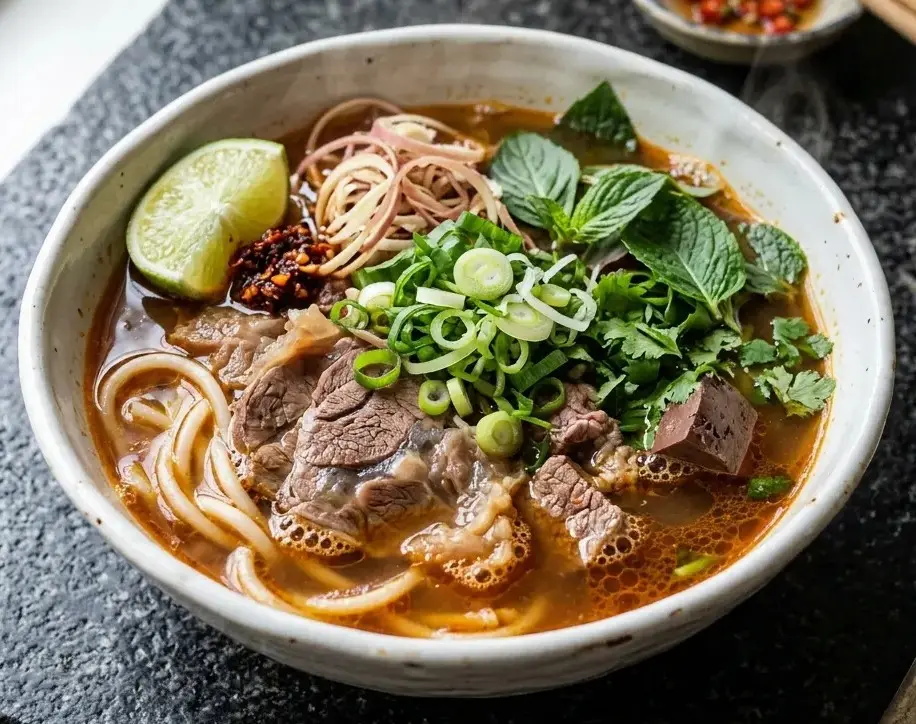
The broth was a deep reddish-orange. The noodles were thick and round, nothing like the flat ribbons I'd had in Hanoi. It was spicy — properly spicy — with a fierce lemongrass backbone and something deeply savoury underneath, funky and complex in a way I couldn't place. A plate of fresh herbs came on the side. We ate in near silence, the way you do when something is considerably better than you expected.
I didn't know what it was called. I found out later.
Then Saigon
Chaotic, traffic-choked, and loud with motorbikes. I have no memorable food story from Ho Chi Minh City, though I did find a restaurant serving a respectable French red wine at a price that made my backpacker's budget wince considerably. Some things follow you wherever you go.
So what is bún bò Huế?
A bún bò Huế recipe starts with understanding what makes this soup different.
It's Vietnam's other great noodle soup — less famous than phở internationally, but arguably more complex, and widely preferred across Vietnam itself. The name translates simply as Huế beef noodle soup, though pork plays an equally important role. It's a central Vietnamese dish, and central Vietnam does not do subtle.
Where phở — a northern dish — is built for clarity and delicacy, bún bò Huế is built for depth. The broth simmers for hours from beef and pork bones, then gets its colour from annatto oil, its heat from chilli, and its extraordinary umami backbone from fermented shrimp paste — mắm ruốc — which sounds alarming and tastes, in context, remarkable. The noodles are thick, round, and chewy. It is a bowl that demands your full attention.
In that Huế front room, I'd ordered phở and been served something considerably more interesting. I have never once complained about that.
Bún bò Huế recipe vs phở — what's the difference?
Both are Vietnamese noodle soups built on long-simmered bone broth. Beyond that they diverge considerably.
Phở is a northern dish. Its broth is clear, delicate, and perfumed with star anise and cinnamon. The noodles are flat. It's refined, almost restrained. Bún bò Huế is central Vietnamese, and central Vietnam does not do restrained. The broth runs a deep reddish-orange, carries a serious lemongrass punch, and gets its umami depth from fermented shrimp paste. The noodles are thick and round, substantially chewier. The heat is real.
If phở is the composed, elegant version, bún bò Huế is the one that grabs you by the collar.
Cooking a bún bò Huế recipe at Casa Adora
I've been working on a bún bò Huế recipe that's achievable without a Vietnamese market on the doorstep — though if you have one nearby, the authentic noodles and shrimp paste are worth the trip.
A few notes before you start.
The shrimp paste. Mắm ruốc is what you want — brown and crumbly, milder than the more pungent mắm tôm. Fish sauce will substitute at a push. Don't be put off by the smell during cooking; it mellows completely in the broth and becomes something altogether more civilised.
The annatto oil. Annatto seeds — achiote — give the broth its characteristic deep reddish-orange colour. In Spain they're available in larger supermarkets and Latin American shops. If you can't track them down, sweet or smoked pimentón works well in the spiced oil — smoked pimentón particularly so.
The noodles. Thick round rice noodles, not flat phở noodles. Asian grocery stores stock them, often labelled simply "Bún bò Huế noodles." Udon makes a respectable substitute if you're stuck.
The broth. This is a genuine labour of love — a two-and-a-half hour simmer, no shortcuts worth taking. The reward is that it freezes beautifully, so make the full quantity and bank the rest for a cold evening when you need something extraordinary.
Ingredients for bún bò Huế recipe
The broth - serves 6
- 700g beef shank, whole
- 700g pork hock
- 1kg pork or beef bones
- 3.5 litres water
- 6 lemongrass stalks, white and pale green parts only, bruised
- 1 white onion, halved
- 60g fresh ginger, halved lengthways
- 1 tbsp rock sugar (azúcar cande or azúcar piedra in Spain)
- 3 tbsp fish sauce
- 1 tsp salt
- 2 tbsp Vietnamese shrimp paste (mắm ruốc)
The spiced oil
- 3 tbsp neutral oil
- 2 tbsp annatto (achiote) seeds
- 3 shallots, minced
- 4 garlic cloves, minced
- 1 lemongrass stalk, finely minced (reserved from above)
- 2 tsp dried chilli flakes, or fresh chillies to taste
To serve
- 500g thick round rice noodles (bún bò Huế noodles)
- 3 spring onions, sliced
- Fresh mint, Thai basil, bean sprouts
- 2 limes, cut into wedges
METHOD
1. Parboil the bones and meat Place the bones, beef shank, and pork hock in a large pot, cover with cold water, and bring to a rolling boil. Boil hard for 10 minutes — significant foam will rise. Drain everything, rinse bones and meat under cold running water, scrubbing away any residue. Clean the pot. This step is non-negotiable for a clear, clean broth.
2. Char the aromatics Hold the onion and ginger halves directly over a gas flame or under a hot grill until the outsides are blackened and blistered — about 4–5 minutes per side. Rinse off the charred skins. This caramelises the natural sugars and adds a smoky depth that cannot be replicated any other way.
3. Build the broth Return the cleaned bones and meat to the pot. Add the water, charred onion and ginger, and the lemongrass stalks — tie them in bundles with kitchen twine for easy removal. Bring to the boil, then reduce to a steady simmer. Skim any remaining impurities from the surface as they appear.
4. Simmer low and slow Simmer uncovered, skimming occasionally, for 2–2½ hours. The beef shank and pork hock should be fully tender but still holding their shape. Remove the meats, set aside to cool, then slice the beef shank thinly and reserve the pork hock whole or in pieces. Discard bones and lemongrass bundles.
5. Season the broth Add the shrimp paste to the simmering broth — dissolve it first in a little warm water if it is very thick. Add the fish sauce, salt, and rock sugar. Taste and adjust: the broth should be savoury, faintly sweet, and deeply umami with a distinct lemongrass backbone.
6. Make the spiced oil Heat the oil in a small pan over medium heat. Add the annatto seeds and stir for 2–3 minutes until the oil turns a deep red-orange. Remove and discard the seeds. Return the coloured oil to medium heat, add the shallots, garlic, minced lemongrass, and chilli flakes. Fry, stirring, for 3–4 minutes until fragrant. This is the heart of the dish's colour and fire.
7. Finish the broth Stir the spiced oil into the broth — start with half and taste, adding more to reach your desired heat and colour. The broth should turn a rich reddish-orange. Adjust seasoning with more fish sauce or salt as needed.
8. Cook the noodles Cook the noodles in a separate pot of boiling salted water according to packet instructions — typically 5–7 minutes. Drain and rinse under cold water to prevent sticking.
9. Assemble and serve Divide the noodles between bowls. Top with sliced beef shank and pieces of pork hock. Ladle the hot broth over generously. Finish with spring onions and serve immediately with a plate of fresh herbs, bean sprouts, lime wedges, and extra chilli on the side. Each person adjusts their own heat and herbs at the table.
Cook's notes
This bún bò Huế recipe — and it is very much a bún bò Huế recipe worth making from scratch — works equally well with beef brisket.
The shrimp paste. Mắm ruốc — brown and crumbly — is the authentic choice. Mắm tôm is more pungent and liquid; not what you want here. Fish sauce substitutes at a push.
The annatto seeds. Achiote in Spain — available in larger supermarkets and Latin American shops. Smoked pimentón is a good substitute in the spiced oil.
The noodles. Thick round rice noodles, not flat phở noodles. Look in the refrigerated or frozen section of an Asian grocery store. Udon works as a substitute.
Pork blood. Traditionally, cubes of congealed pork blood are added at the very end. Many home cooks skip it — no shame in that.
Make ahead. The broth freezes beautifully. Make the full quantity and bank the rest.
A final thought
I went to Vietnam expecting phở. I came home talking about something I'd accidentally ordered in a stranger's front room in Huế, in a city I hadn't known was the gastronomic capital of the country.
Make it on a cold evening. Eat it with cold beer if you can manage it — bia hơi if you happen to be in Hanoi, something from the fridge if you're not. Squeeze the lime generously. And if someone ever waves you into what looks like a bar in Huế, go in without hesitation.
Serve this bún bò Huế recipe straight from the pot, piping hot, with everything on the table so each person can build their own bowl.
This bún bò Huế recipe is part of my Beef and Veal Recipes collection. It joins a growing collection of beef and veal recipes — from quick weeknight beef mince suppers to slow-braised veal dishes worth waiting for — all gathered in one place. Browse the full collection at Beef and Veal Recipes — The Flexible Chef's Complete Collection.
Wonky photos, proper food, genuine adventures — The Flexible Chef.