Nearly Jongga — A Casa Adora Kimchi with Pimentón
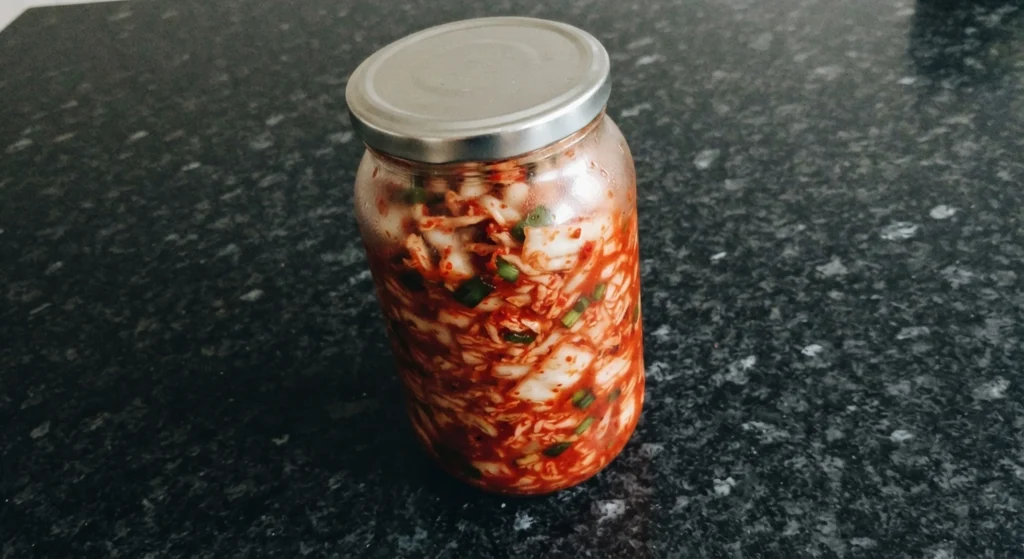
Jongga is the global benchmark for packaged kimchi — the jar you find in Asian supermarkets across Europe, the standard against which homemade kimchi gets measured. I have never seen it in rural Jaén. What I do have is white cabbage, garlic, frozen ginger, spring onions, fish sauce, and a pimentón solution that took about thirty seconds to work out: three parts Pimentón Agridulce to one part Pimentón Picante. This is my homemade kimchi recipe, and it is nearly Jongga. Nearly.
Kimchi is a Korean fermented vegetable dish — most often napa cabbage or radish, seasoned with garlic, ginger, chilli and salted seafood, and left to lacto-ferment into something spicy, sour, salty and deeply savoury. There are over a hundred varieties. This is not one of them. This is a Casa Adora version, made with what was available, and it is considerably better than no kimchi at all.
How to Make This Homemade Kimchi Recipe — The Andalucían Solution
Gochugaru — Korean red pepper flakes — is the ingredient that stops most home cooks outside Asia from attempting kimchi. It has a specific medium heat, a deep red colour, and a fruity, slightly smoky character that is hard to replicate. Hard, but not impossible. A blend of Pimentón Agridulce (bittersweet) and Pimentón Picante (hot) at a 3:1 ratio gets you surprisingly close — the heat level is right, the colour is right, and the Vera smokiness adds something of its own that is, frankly, not unwelcome in a ferment.
White cabbage stands in for napa cabbage here. It is denser and firmer, which means it stays crunchier through the ferment — a good thing. The flavour is more robust, which suits the pimentón substitution well. This is not a compromise. It is an adaptation.
Ingredients
Makes 1–2 x 750ml jars
For the salted cabbage:
- 1kg white cabbage, mandolin-sliced or finely shredded
- 25g fine sea salt
For the kimchi paste:
- 4 garlic cloves, minced
- 1 tsp fresh ginger, grated (frozen ginger works perfectly — grate straight from frozen)
- 3 tbsp Pimentón Agridulce
- 1 tbsp Pimentón Picante
- 2 tbsp fish sauce
- 4–5 spring onions, cut into 3cm lengths
Method
Salt the cabbage — Slice the cabbage finely on a mandolin or shred by hand. Put it in a large bowl, scatter over the 25g of sea salt, and toss well. Leave for 1–2 hours — longer than sauerkraut — until the cabbage has wilted significantly and released a good pool of liquid. The longer rest draws out more moisture, which gives a better ferment.
Rinse and dry — Rinse the cabbage thoroughly under cold running water to remove the excess salt — taste it; it should be pleasantly salty but not aggressively so. Squeeze out as much water as possible by hand, working in batches. This step matters: too much residual water dilutes the paste and slows fermentation.
Make the paste — Combine the minced garlic, grated ginger, Pimentón Agridulce, Pimentón Picante and fish sauce in a bowl and mix to a rough paste.
Combine — Add the squeezed cabbage and spring onion lengths to the paste. Mix thoroughly with your hands — wear gloves if you have them, the pimentón will stain — working the paste through every strand of cabbage until evenly coated.
Pack the jars — Pack tightly into sterilised jars, pressing down firmly so the cabbage compresses and any liquid rises. Leave 2–3cm of headroom at the top — the kimchi will expand as it ferments. Do not fit airlock lids here; kimchi needs to release gas during its initial room-temperature ferment, so a loosely fitted lid or a lid left slightly ajar is correct.
Ferment — Leave at room temperature, out of direct sunlight, for 1–2 days. In the August heat at Casa Adora — 28–33°C — fermentation will be vigorous and fast; check after 24 hours. Press the cabbage down if it has risen above the liquid. Once it smells pleasantly sour and tangy, move to the fridge. It will continue to ferment slowly in the cold and is better after a week.
If you've made my homemade sauerkraut recipe, the salting and lacto-fermentation process behind this homemade kimchi recipe will be familiar — same principle, just with a paste rather than salt alone.
A Note on the Pimentón
Pimentón de la Vera is smoked — which gochugaru is not. That smokiness is present in this kimchi and it is not a flaw. It is the Andalucían signature on a Korean dish, and it works. If you want to reduce the smoke character, use unsmoked Spanish sweet paprika for the agridulce portion and keep the Pimentón Picante for heat. But I would not bother. This homemade kimchi recipe tastes of somewhere, which is more than you can say for most jars.
This homemade kimchi recipe is part of my Nearly Series, a collection of from-scratch versions of the jars and bottles that are unavailable, eye-wateringly expensive, or just not the same in rural Andalucía. It also features in my Fermentation Hub and my Gut Health Recipes collection — real food from a rural Andalucían kitchen, built around fermented foods, high-fibre pulses, wholegrains and prebiotic-rich ingredients.
All recipe hubs → Recipe Hubs
Find more recipes and food adventures here.
Wonky photos, proper condiments, genuine adventures — The Flexible Chef