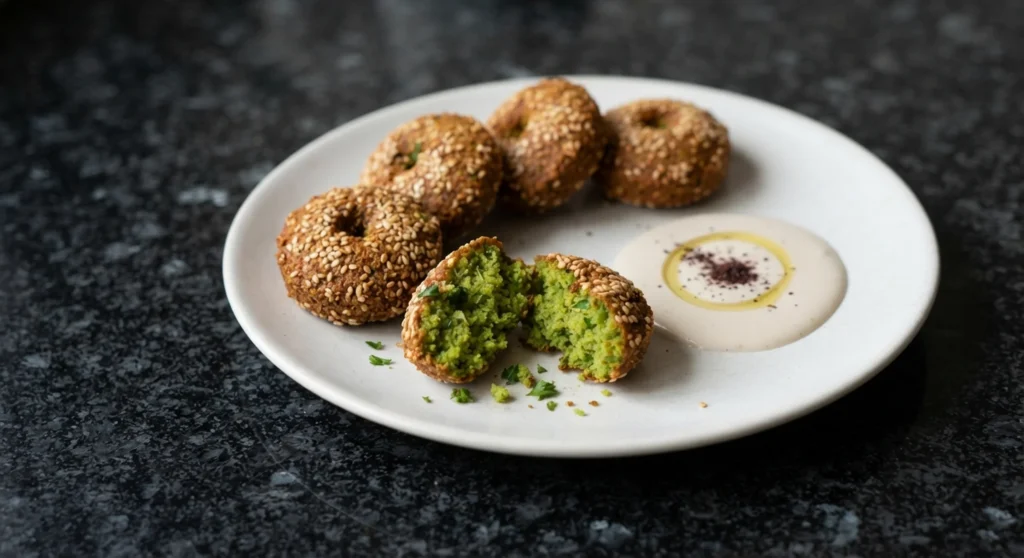
Ta'mia — Egyptian Falafel with Fava Beans (Taameya)
Every falafel you have ever eaten began with taameya.
Taameya — also spelled ta'mia, or ta'ameya — taameya is Egypt's traditional fava bean falafel, made with soaked split dried fava beans rather than chickpeas. It is older than the Levantine version, older than the chickpea debate, older than most of the food arguments the internet currently enjoys. Fava beans have been cultivated in the Nile Delta for over four thousand years. The ancient Egyptians were soaking, mashing and frying legumes with local herbs long before the word falafel existed.
The chickpea version came later — as the concept of the fried legume patty spread north into Syria, Lebanon, Jordan and Palestine, cooks swapped fava beans for chickpeas because that was what was locally available. The fava bean original stayed in Egypt. Taameya is what falafel looked like before it travelled.
The Coptic Connection
The most widely accepted historical theory credits Egyptian Coptic Christians with popularising ta'mia as it exists today. During Lent and other periods of religious fasting — of which the Coptic calendar has many — meat was forbidden. Taameya provided protein, substance, and satisfaction without it. A hearty, budget-friendly, deeply nourishing meat substitute eaten during religious fasting: the same logic that makes it a Ramadan staple today, different faith, same principle. Fava beans appear alongside lentils in the oldest surviving Egyptian recipes — including this Ancient Egyptian lentil and onion stew on TFC.
The Andalusian Thread
There is no direct record of ta'mia arriving in medieval Al-Andalus. The connection runs differently. During the Islamic rule of Iberia from 711 to 1492, Arab and North African farmers and scholars transformed Andalucían agriculture — introducing new irrigation techniques, spices, and crops. But Andalucía already had the chickpea, firmly established since Roman times, and Moorish Andalusian cookbooks feature panizas — chickpea fritters — and spiced legume purées rather than the fava bean taameya of Egypt.
The fava bean and the chickpea took different paths. Egypt kept the fava bean. Andalucía kept the chickpea. They never quite converged.
Until now, arguably. Travel through Córdoba, Granada or Seville today and you will find Arab-Andalusian restaurants serving Falafel Andalusí alongside local olive oils and Mediterranean herbs — a conscious nod to the shared history between southern Spain and North Africa. The circle has closed, even if it took seven centuries.
I am making this Egyptian falafel recipe thirty-five kilometres from Jaén — deep in the landscape that was Al-Andalus. The chickpea version was made here for centuries. This is the older one.
If you want the chickpea version, my Spicy Falafels, Goat's Cheese & Salad Pittas is the TFC take on the Levantine original.
What Makes Taameya Different
Three things separate this fava bean falafel from every other falafel recipe:
Fava beans, not chickpeas. Split dried fava beans, soaked overnight, give a creamier, earthier base than chickpeas and a distinctly different flavour — more mineral, less nutty.
Fresh herbs throughout. Parsley, coriander and dill are blended into the mixture, not just added as garnish. This is what gives taameya its characteristic vivid green interior — the herbs are structural, not decorative.
Whipped for air. The blended mixture is beaten to incorporate air before frying, giving the inside a light, almost fluffy texture while the outside stays deeply crisp. This is the step most falafel recipes skip and the reason taameya has a different texture entirely.
Taameyaia — Fava Bean Falafel, The Recipe
Serves 1 as a starter (6–8 pieces)
INGREDIENTS
- 150g split dried fava beans, soaked overnight in cold water
- 1 small onion, roughly chopped
- 3 garlic cloves
- Large handful flat-leaf parsley
- Large handful fresh coriander
- 1 tsp dried dill (or ½ tsp dill seeds)
- 1 tsp ground cumin
- 1 tsp ground coriander
- ½ tsp sweet paprika
- ¼ tsp cayenne
- ½ tsp fine sea salt
- ½ tsp baking powder
- 3 tbsp sesame seeds
- Sunflower or vegetable oil for frying
For the tahini sauce:
- 2 tbsp tahini
- Juice of ½ lemon
- 1 garlic clove, minced
- 2–3 tbsp cold water
- Pinch of salt
METHOD
Soak the beans. Cover the split dried fava beans in cold water and soak overnight — at least 12 hours. They will double in size. Drain thoroughly before using. Do not cook them — the raw soaked bean is what you want.
Blend the mixture. Drain the soaked fava beans and add to a pulse blender with the onion, garlic, parsley, coriander, dried dill, cumin, ground coriander, paprika, cayenne and salt. Pulse in short bursts — you want a rough, grainy paste with texture, not a smooth purée. Stop before it becomes hummus.
Whip for air. Transfer the mixture to the bowl of your stand mixer fitted with the whisk attachment. Add the baking powder and beat on medium-high for 2–3 minutes. The mixture will lighten in colour and become slightly aerated. This is the step that gives taameya its interior texture — don't skip it. Refrigerate for 30 minutes if time allows; this helps the mixture hold together during frying.
Shape. With wet hands, shape the mixture into small patties roughly 4cm across and 1.5cm thick — flatter than a ball, more like a thick disc. Roll each one in sesame seeds, pressing gently to coat.
Fry. Heat 3–4cm of oil in a heavy pan to 175°C. Fry the taameya in batches for 2–3 minutes per side until deeply golden and crisp. Don't crowd the pan. Drain on kitchen paper.
Make the tahini sauce. Whisk the tahini, lemon juice and garlic together — it will seize initially. Add cold water a tablespoon at a time, whisking until smooth and pourable. Season with salt.
Serve immediately — taameya on a plate, tahini sauce alongside, lemon wedge, a scattering of parsley. Warm pitta if you have it.
Notes
Split dried fava beans are essential — whole dried fava beans need their skins removed, which is time-consuming. Split fava beans are already skinned. Find them in Middle Eastern grocers or online; in Spain, habas secas partidas are increasingly available in health food shops and online.
The mixture can be made ahead and refrigerated overnight — it actually improves with resting, becoming easier to shape and holding together better in the oil.
If the mixture is too wet to shape, add a tablespoon of plain flour. If too dry, a tablespoon of cold water.
Oil temperature matters. Too cool and the taameya absorb oil and turn greasy. Too hot and the outside burns before the inside cooks through. 175°C is the target — a cube of bread should brown in 30 seconds.
Egypt's other great contribution to the spice cupboard is dukkah — worth making while the sesame seeds are out.
In the UK, fava beans are sold as broad beans — the same thing. Dried split broad beans work identically here. Find them in health food shops, Middle Eastern grocers, or online. In Spain, look for habas secas partidas — increasingly available in health food shops and larger supermarkets.
FOOTNOTE
This Egyptian falafel recipe features in my North African Recipes collection — Morocco, Tunisia, Algeria, Libya, Egypt and Sudan, cooked at Casa Adora in rural Andalucía.
It also features in my Cooking Through History collection — where ancient recipes meet a modern kitchen. Fava beans have been cultivated in the Nile Delta for over four thousand years. This is as close to an ancient Egyptian recipe as a home kitchen gets.
This recipe is also part of my Veggie & Vegan Recipes collection.
Find more recipes and food adventures here.
Wonky photos, proper food, genuine adventures – The Flexible Chef